Saturday, April 28, 2012

Smart Gals Sip – Drinks With Sarah Bird, Nanci Wilson and Carla Jackson At The Four Seasons


When best-selling author, screenwriter, and Texas Monthly columnist Sarah Bird (pictured far left) said she was “addicted to my blog” I thought, “OK, I can die now. My life is complete.” When she posted the following message on Facebook after we had drinks Thursday night, I nearly died laughing,  “GADSZOOKS did we have a good time!! Thank you to SueAnn, Kween of the Social Konnectors and a blue-nailed hoot to boot!!” Obviously, the woman has a way with words, and although I’m not worthy to touch the hem of Sarah’s garment when it comes to writing, I guess I’m worthy enough to share wine, cheese, tuna tartare, quesadillas, nachos and french fries with her. I asked the waitress at the Four Seasons to bring us three of their best hors d'oeuvres and she apparently thought I said bring them all! Anyway, we ate well. I met Sarah through my blog and through Facebook, and what a fun connection that has been. Sarah is in the middle of a top-secret and very exciting project that I can’t tell you about, but which involves her famous book, The Flamenco Academy. Oh yes, and go buy all of her books. You can thank me later. 

Nanci Wilson (pictured above center) is an Investigative Reporter with two Emmy awards, six Emmy nominations, a National Journalism Award, and an Edward R. Murrow Award for Investigative Reporting. I met Nanci at her and my grandsons’ joint-birthday party in San Antonio. Just so happens that her grandson and my grandson are best friends.  It took us about 20 seconds to become friends as we stood in the kitchen at my daughter’s ranch, ignoring the birthday clamor going on around us. Nanci had Sarah, Carla and I staring drop-jawed at her stories of the investigations she has been and currently is involved in – no secret information was exchanged as what she told us was already a matter of public record, but the inside scoops were tantalizing and fun! I want to be Nanci’s “deep throat,” metaphorically speaking of course. I know a couple of illegal things going on in Austin that haven’t been investigated yet! (Nanci – call me). 

If you think that Carla Jackson (pictured above right) cannot possibly be as interesting as Sarah and Nanci, you’re wrong. Carla is the Co-Producer of 2011 Austin Film Festival Selection, San Diego Black Film Festival Selection, and DC Independent Film Festival Selection, A Swinging Trio. Be sure to watch the movie trailer. It is hot and provocative!! Carla is also the Associate Director, Center for Public Policy/Political Studies at Austin Community College, although I’m not sure when she has time to sleep. She’s also currently producing a feature-length documentary, "Black Sun," that chronicles two celestial events: the May 20, 2012 annual solar eclipse and the November 14, 2012 total solar eclipse. The movie follows two African American astrophysicists who study the solar atmosphere during eclipses. The film's goal is to inspire more minority children to choose science-related careers. I was so impressed by Carla and her descriptions of moviemaking that I invested a little money in the "Black Sun" project, which entitles me to my name in the movie credits! Woo hoo! I'm a movie producer! Actually, you can be too. Go to this link and sign up to support the project.

As you’ve heard me say before, I’m a recluse, and these Very Smart Gals get-togethers are my self-induced therapy, but the time I spent with Carla, Nanci and Sarah was more than therapy, it was fantastic fun! 

One Hundred Things My Mother Taught Me A Million Times – Chapter 84


#84 – “If you have an injury make a poultice and tie it on the injury with a soft rag to draw out the bad stuff.”

When I went to the list of the 100 things my mom taught me a million times and saw #84, my first thought was, “What in the hell am I going to say about that?” But after I woke up this morning, excited to finally have time to blog, then drank too much of too strong coffee, the thoughts came rushing out so fast they were like bodies piled at the only exit of a burning building. So here are the fortunate survivors (thoughts). Writing is such wicked fun.

“Poultice” is a creepy word and even a creepier thing to me. Every time my mother said the word “poultice,” I would involuntarily twitch, look around to see if anyone else heard her, and then visualize the Wicked Witch of the East’s ugly stepsister – the one with hairs growing out of her facial moles.

Perhaps you’re wondering what a poultice is? Although there are many variations on the ingredients for a poultice, mom’s poultices were flour and hot water mixed to the consistency of cookie dough, spread onto a soft rag (important part of the formula), and then applied to anything that hurt: bug bites, snake bites, broken bones, bronchial congestion, splinters, blisters, gunshot wounds, and day-to-day booboos.

The principal behind this ancient, yet fairly effective formula/technique, is that as the poultice “paste” dries and cools, it “pulls out” the bad stuff – infection, inflammation, bullets and splinters – taking the pain with it. A little research (very little) revealed that Native Americans used mashed pumpkin as a poultice, and the Romans used porridge, which makes sense as no one really wants to eat porridge anyway – well, except me. I’m an inexplicable Malt-O-Meal freak. Click on Read More Below...

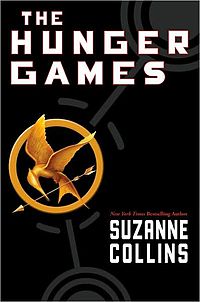
The Hunger Games by Suzanne Collins


I sort of liked The Hunger Games – the effortless read; the way I knew the definition of every word in the book; the lack of thinking involved. Although the book was written for teens, it is enjoying universal popularity, not unlike the Harry Potter books/movies. I’m not sure what that says about us as a society – we love adventure at any age, or we dumb-down to relax. Just the fact that millions of teens are reading is a good thing.

For the three people out there who haven’t read The Hunger Games (yet), it’s about a future dystopic society in which the evil rulers hold an annual game pitting teens chosen by lottery from each geographic district, against teens from other districts for a fight to the death. The winner gets food for their family and to, well, you know, not be dead.

The main character is 16-year-old Katniss Everdeen, whose name I love.  I found it refreshing that Collins  (pictured right) had a female heroine with two boyfriends, unlike the typical theme of a male hero with two women cat fighting over him.

Collins’ writing was, hmmm, I want to say, “good enough.” It didn’t make me want to recite passages, but it told the story well, and in some parts of the book was brilliantly descriptive, like her narrative about the costumes the contestants wore.

Of course the end is pretty predictable, but most of the story is interesting, exciting and compelling. I do recommend that you read The Hunger Games, just for fun; and if you need the relaxing benefits of more mindless entertainment, the trilogy, which includes Catching Fire and Mockingjay. Not that I’ve read them. I haven’t, and probably won’t.

I will, however, watch the movie, but only because the girl that plays the part of Katniss, Jennifer Lawrance (pictured left), was so wonderful in the Indy film, “Winter’s Bone.” I am always reticent to watch movies made from books I’ve read because they seem to disappoint me and not do the books justice. I somehow doubt that will be an issue with The Hunger Games.

The Snowman by Jo Nesbø


Here’s what I liked most about The Snowman: (1) The main character. (2) The plot twists.

What I didn’t like about The Snowman: (1) For some reason the Scandinavian names of the characters in the book made it illogically hard for me to keep up with who was who. (2) Other than the main character, I didn’t engage with the other people in the book.

Both #(1’s) above are somewhat related because the main character in the book had one of the few pronounceable names – and what a name it was – Harry Hole. I kid you not.  Harry wasn’t a particularly likable guy, but he carried the plot along well enough.

On the other hand, Nesbø was masterful at taking the reader down dead-end trails and making you read on to find out what the hell was going on. 

Here's the plot. There are a series of murders of women and Harry Hole (snicker, snicker), in between drinking binges, tries to find the killer. His efforts are pretty lame and the plot has no backbone, but you really don't care because there is suspense, blood, drama, a surprise ending, and the story moves along at a quick clip.

In the photo to the left, author Joe Nesbø looks like the type of guy I would fall tragically in lust, I mean love, with - a bad boy.  

In the photo to the right, he looks like a psychotic meth-dealer.

Need a good murder mystery to take your mind off of ________ (fill in the blank)? Read The Snowman by Joe Nesbø.

Sunday, March 18, 2012

One Hundred Things My Mother Taught Me A Million Times – Chapter 83

#83 – “Tear your bread into little pieces before you put gravy on it.”
 (Me, age 10, 1958)

Bread and gravy was a staple in our house, and tearing the bread into little pieces before mom put gravy on it was a fun ritual when I was a small child. (For you grammar nazis and Yankees, that's "bread with gravy"). Of course the purpose was to make it easier for little hands, but for me it was also a sensual experience – the softness, fragrance, and yummy-ness of the bread, and the anticipation of the warm and creamy gravy. Of course it wasn’t until I was much older that I realized that the feelings I was experiencing at the age of 10 were closely related to the feelings I would have as a grown and sexually active woman.

Science confirms that we’re hard-wired for the sensual correlation between food and sex. Men are attracted to women for sex and women are attracted to men for food, but not exactly in the way it sounds. At the very biological level, men are driven to procreate, and women are driven to feed children, in vitro or out. And although most women have been able to feed themselves and their children for years, just as the female praying mantis kills and eats her sexual partner immediately after consummation of sex, women have been using sex to get a nice dinner out forever. CLICK ON READ MORE BELOW...

Just Kids by Patti Smith

I read somewhere that Just Kids begins as a love story and ends as an elegy, and I repeat that because it really sums the book up quite nicely. The story begins in 1967, when 20-year-old Chicagoan Patti Smith moves to New York City, meets artist Robert Mapplethorpe, and begins a lifetime of love and friendship. As most people know (as such, not a spoiler), Mapplethorpe’s lifetime was cut short as he died of complications from AIDS in 1989 when he was 42. Before he died, Mapplethorpe asked Smith to “write his life,” and Just Kids, which won a National Book Award, is that story – at least the story from Patti Smith’s perspective, anyway, which I found entertaining and intellectually stimulating.

Here’s a little perspective on Smith and Mapplethorpe (pictured). Smith, who is commonly referred to as the ‘Godmother of Punk,’ is famous for her music and poetry, and is probably most well know for her performance of Because The Night, which she co-wrote with Bruce Springsteen.

Robert Mapplethorpe, who was known in the art world for his black and white photos of flowers and nude men, lept into the national consciousness when public funding got tangled up in a show of his homoerotic and provocative religious art, and triggered a giant controversy. Remember the crucifix-in-a-jar-of-urine brouhaha? CLICK ON READ MORE BELOW...

The Paris Wife by Paula McLain


Paula McLain’s novel, The Paris Wife, is the minimally fictionalized story of Ernest Hemingway’s marriage to Hadley Richardson, his first of four wives. If you’ve read it you know Hadley Richardson Hemingway was a rather boring gal, and Hemingway was the cliché of a tortured artistic soul. You also know that the setting for most of the book, Paris in the 1920s, doesn’t get much more interesting, especially when you’re hanging out with the likes of Gertrude Stein, James Joyce and F. Scott and Zelda Fitzgerald. Woody Allen’s 2012 Oscar nominated Midnight in Paris is an entertaining glimpse into that era as well.

Despite her lackluster persona in the book, Hadley Richardson does have an interesting backstory riddled with tragedy. Her father committed suicide, her sister  died of burns sustained in a house fire, and Hadley spent her 20s caring for her ailing mother.
Out of the blue appears handsome,  and nine-years-younger Hemingway who sweeps a borderline homely Hadley off her feet. Although Hemingway swears to his adoration of Hadley, I couldn't help but imagine that he was more attracted to her trust fund than her charms. Hemingway's biographer Jeffrey Meyers apparently agrees, as he said, "With Hadley, Hemingway achieved everything he had hoped for ... a comfortable income, a life in Europe." CLICK ON READ MORE BELOW...

Saturday, March 10, 2012

One Hundred Things My Mother Taught Me A Million Times - Chapter 82

That's Becky Beaver behind the sign (left).  Join the "Seeing Red" and "Don't Mess With Texas Women's" campaign to restore basic preventive healthcare and family planning for women.

#82 – “Make sure you sit out in the sun to get your vitamin D, but don’t get the sun on your face.”

About a month ago I was in a meeting with a client, whose nonprofit serves people with intellectual/developmentally disabilities, and someone mentioned that at least one scientist studying autism thinks that mothers' vitamin D deficiency, resulting from admonitions  to stay out of the sun,  may be playing a part in the increase in children born with autism. At that moment, mom’s lesson #82 sparked into my mind.

I remember many occasions, after I was grown and married, when I would visit my mom and she would say, “Let’s go sit out in the sun. We need to get our vitamin D.” Or I would arrive at mom’s, and she would be sitting out in the sun - always the morning sun - surrounded by her beloved morning glories and reading The New York Times or The Dallas Morning News. Click on Read More Below...

There’s Jews in Texas? by Debra Weingarten - Winner of the 2011 Poetica Magazine Chapbook Contest

When I launched the Gals-Very Smart Gals, I knew Debra Weingarten would be a member by virtue of her birthright – her mother, and my friend, Ruthe, was a famous women’s historian. What I soon learned was that her membership would have less to do with her ancestry than her personal acuity. One has only to read Debra’s recently published book of poetry There’s Jews in Texas? to figure that out. You also know if you met her at my recent Gals-Very Smart Gals cocktail party. Many of the Very Smart Gals at the party commented on meeting interesting and delightful women. It is notable that many of them were talking about Debra (pictured below).

There’s Jews In Texas? is Debra's funny, fun and touching poetry about growing up Jewish in Dallas. What is possibly more important is that Debra’s poetry is about “being different,” which anyone can relate to – regardless of whether it’s religion, the color of your skin, or socio-economic status.  Nothing can tell you how poignant and endearing Debra’s poetry is better than Debra’s poetry. Here is one of my favorites:

Second Grade, Part One

In far North Dallas in the early 1960s,
At Thomas C. Gooch Elementary School
We sat in rows alphabetically by last name.
Mark Washington in front of Deborah Winegarten

And our locker assignment came in that order, too.
So when the only Jew, Me, was assigned
A locker with the only Negro, Him.
I naturally thought

They were putting the Negro
And the Jew together
Because we had to look out for one another.
And I’ve been trying to do that, ever since.

I also loved Debra’s poem about a man telling her she was going to burn in hell because she was Jewish. When Deborah ran home crying, her mother took Debra’s shoulders in her hands, looked her firmly in the eyes and said,

That’s okay, honey, don’t worry.
We’re Jewish.
We don’t believe in hell.

In the words of Rabbi Neil Blumofe, “Oy, Devoreh. A jewel in our shul…”

Click here to buy There’s Jews In Texas? or you can purchase it at BookWoman in Austin. 

You’ll re-read it again and again, as have I.


Holiday Family PJ Photos - Funny, Fun!

This year we decided to start a new family tradition. We would give all our children and grandchildren "Christmas" pajamas with their names on them, and challenge them to take a fun and clever family photo wearing their PJs. The family that took the most clever photo would win a cash prize. My husband I participated as well. I thought the kids came up with really fun photos!

Mine and Crouse's first, then the kids by order of birth.


Eldest son, Cuatro and his wife Lovie, and their son Quenten and daughter Khloe Noelke. They named this photo the "Ranch-Billies," and as you can see they are a gorgeous family ...  and  they're all "packin!"


Next is my daughter JoLene, her husband James, and their children Sydney, Will and Cassie. We had to put a little black-out on their booties to be able to show these! The writing on their booties says MERRY CHRISTMAS! Very clever, very funny.


Last, but far from least is my youngest son, Colt and his wife Heather, and daughters Gracie, Taylor, and baby Ember Elizabeth. Cute, cute, cute.

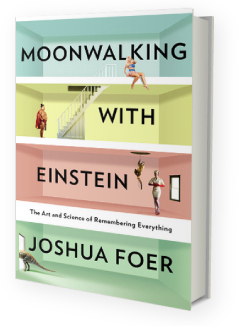
Moonwalking With Einstein: The Art and Science of Remembering Everything by Joshua Foer

I will never again see Claudia Schiffer’s name without instantly imagining her swimming in a vat of cottage cheese. I’ll let you ponder that while I tell you about Foer’s book Moonwalking With Einstein, which is about mnemonics (one of my favorite words).

Joshua Foer, a journalist in the process of researching “the smartest person in the world,” ends up at the US Memory Championships and discovers that people who can memorize the order of 27 decks of cards in an hour are not geniuses, but have learned and mastered a memory trick used primarily in memory competitions called “memory palaces.” Although it is very tempting to tell you how memory palaces work (believe me, they do), instead I suggest that you read Foer’s book, which is well worth the money, time and effort.

Foer ends up becoming fascinated with the memory competition world to the point that he seeks out and trains with a professional memory expert, then enters the US and International memory competition – all of which is pretty fascinating. Know what country is famous for their memory experts? Germany. Click On Read More Below...

The Night Circus by Erin Morganstern

I liked The Night Circus by Erin Morganstern, but I didn’t LOVE it. I wanted to; I really did. The cover made my eyes sparkle, and my imaginings of what a night circus might be made my heart go “bumpity bump.” In fact, my desire to love this book was so strong that hope carried me to the very end, although I was irritated and grumpy the entire trip. Why? Well, probably because I felt the story could have been, should have been, “more.”

First, the publisher’s book description, which I found entrancing:
The circus arrives without warning. No announcements precede it. It is simply there, when yesterday it was not. Within the black-and-white striped canvas tents is an utterly unique experience full of breathtaking amazements. It is called Le Cirque des Reves, and it is only open at night.  But behind the scenes, a fierce competition is underway-a duel between two young magicians, Celia and Marco, who have been trained since childhood expressly for this purpose by their mercurial instructors. Unbeknownst to them, this is a game in which only one can be left standing, and the circus is but the state for a remarkable battle of imagination and will. Despite themselves, however, Celia and Marco tumble headfirst into love-a deep magical love that makes the lights flicker and the room grow warm whenever they so much as brush hands.

I soon found out the publisher’s description promised more than the book would deliver.  Here’s what I liked. I liked the premise – a mysterious and very different circus that wondrously arrives in the night. I liked the promise – a battle between magical powers and star-crossed lovers. I liked the physical - the elaborate visuals woven by Morganstern. Click On Read More Below...

Sunday, February 5, 2012

Very Smart Gals Cocktail Party

It was a star-studded night when 50 of the Very Smart Gals dressed in vintage cocktail congregated to eat fab food provided by Nicole Davenport Executive Chef/Owner of Sugar & Smoke Restaurant, Fredericksburg; sway to the coolest Jazz from the Jeff Lofton Trio; hear about the Nobelity Project’s Building Hope; and gawk at the Austin cityscape from the 32nd floor of the Four Seasons Residences. Click On Read More Below To See The List of Attendees:


One Hundred Things My Mother Taught Me A Million Times – Chapter 81

#81 – “Have a good cry. That’s why women live longer than men, because they cry.”

In 1988 when I read Larry McMurtry’s pivotal novel, Lonesome Dove, it really pissed me off. “Cowboys, guns, horses and whores,” I ranted to my husband, “And all the women are a bunch of bawl-babies.”  After crying my eyes out for ten years between 1978 and 1988 (another story, another day), not only was my reservoir of tears depleted, I was also really tired of crying. Then I went into my bitter, defensive phase, and felt that when women cried it made them seem weak. Like Scarlett O’Hara in Gone With The Wind who swore, “I’ll never be hungry again,” I was determined to never cry again, and let me tell you that can make you hard.

In fact, it made me so hard that I pretty much built a wall around my heart, and the only people allowed in were my children and a few close friends. It took me 10 years to let my husband in, and another 10 years to let myself feel emotionally free to cry.

Of course I had to consult my KOAT (knower-of-all-things: Wiki) to get to the bottom of this crying thing, and found some pretty interesting information. Click on Read More Below...

Rules of Civility by Amor Towles

I was immediately captivated by Amor Towles’ book Rules of Civility when in the forward, main character Katey Kontent (accent on tent), at a 1966 art show at the Manhattan Museum of Modern Art, spots a photograph of a long-ago unrequited love. In that moment a flood of memories and emotions send her heart and mind tumbling. Hasn’t that happened to you? You catch a glimpse of someone in a crowd who only vaguely resembles a paramour from your past who warped your world, or hear a song that reminds you of them, and you are momentarily transported to a parallel universe as adrenalin pops like little bubbles on the surface of your skin.

The photograph Katey saw was that of Tinker Grey, and the time was 1937. Katey and her best friend Eve Ross, both farm-grown gals from the midwest living in and on the excitement of Manhattan and little else, meet wealthy banker Tinker Grey and their lifestyles take a dramatic turn towards that of the rich and unaccountable.

Eve, unlike Katey, is from wealth that offers no allure and makes her a recklessly attractive gal who gets it all and doesn’t want it. Katey is a low-income, high-intelligence, Thoreau-ish gal torn between principal and high society. Tinker is a man of humble origins who compromises just about everything to canoodle with the upper crust. These make up the main characters of the book. But there is one more character I found intriguing, Anne Grandyn, a wealthy doyenne who helps exceptionally bright Katey get a coveted position as a reporter at Conde Nast, and who also unapologetically buys young, ambitious men, including Tinker Grey.

I found myself enamored with the way Towles portrayed the 30s women characters. They were clearly still considered intellectual subordinates by the masculine-dominated society, and yet they cleverly and covertly manipulated control. And the promiscuity! Guess what? Our generation didn’t invent it. No seriously, we didn't. Click on Read More Below

Saturday, January 14, 2012

BEST AND WORST BOOKS READ IN 2011

THE BEST
(Click on the Title To See My Review)


BEST FICTION PUBLISHED AND READ IN 2011
The Gap Year by Sarah Bird
Room by Emma Donoghue
Rules Of Civility by Amor Towles


BEST NON-FICTION PUBLISHED AND READ IN 2011
Stories I Only Tell My Friends by Rob Lowe
In the Garden of Beasts: Love, Terror and an American Family 
in Hitler's Berlin by Eric Larson
The Intentional Networker by Patti DeNucci
Steve Jobs by Walter Isaacson 
Destiny Of The Republic: A Tale of Madness, Medicine and the 
Murder of a President by Candice Millard


BEST FICTION  PUBLISHED PRIOR TO BUT READ IN  2011
True Grit by Charles Portis
The Automatic Detective by A. Lee Martinez
Half Broke Horses: A True-Life Novel by Jeannette Walls
The Talented Mr. Ripley by Patricia Highsmith
Still Alice by Lisa Genova


BEST NON-FICTION PUBLISHED PRIOR TO BUT READ IN 2011
Unbroken: A World War II Story of Survival, 
Resilience and Redemption by Laura Hillenbrand
Genghis Kahn And The Making Of The Modern World by Jack Weatherford
Cleopatra: A Life by Stacy Schiff
Helter Skelter by Vincent Bugliosi and Curt Gentry
Learning to Breathe by Alison Wright


PRETTY DAMN GOOD
The Best American Science Writing
The Best American Nature Writing
The Best American Medical Writing


OK
The Best American Travel Writing
The Best American Sports Writing
Are Men Necessary: When Sexes Collide by Maureen Dowd


THE WORST

REALLY TRIED MY PATIENCE
Wine & War: The French, the Nazis, and the 
Battle for France's Greatest Treasure 
by Donald Kladstrup and Petie Kladstrup
The Night Circus by Erin Morgenstern


MADE ME WANT TO HURT SOMEONE


BOOKS I WANTED TO READ IN 2011 BUT DIDN’T, YET
The Pale King by David Foster Wallace
Information: A History, A Theory, A Flood by James Gleick
The Tiger’s Wife by Tia Obreht
Boomerang by Michael Lewis
Fatal Invention: How Science, Politics and Big Business 
Re-Create Race In The Twenty-First Century by Dorothy Roberts
Life Itself by Roger Ebert
Salvage the Bones by Jesmyn Ward
Lost in Shangri-La by Mitchell Zuckoff


Friday, December 23, 2011

One Hundred Things My Mother Taught Me A Million Times – Chapter 80


Photos are of our very loved family pets, 
Velcro and Little Red.

#80 – “Never buy anything until it goes on sale.”
This one of one hundred things my mom taught me a million times absolutely did not stick. I am simply horrible when it comes to shopping and buying. Mom wasn’t a shopper, but she was extremely frugal, so I have no idea where my penchant for overspending came from. Well, I guess it could have come from my dad. I vaguely recall that right after dad died, mom had to sell practically everything we owned to pay off all of the bulldozers and graters that my dad “owned” for his road construction company. And then there was dad’s gold mine in New Mexico and the racehorses. Anyway, I obviously didn’t get mom’s money/good judgment gene.

Here’s another dirty little secret. When I was very young, probably 8-10 years old, I read somewhere that the Queen of England never wore any piece of clothing twice and I was entranced. Isn’t it crazy the things that stick in your psyche? Well, this is something I’ve struggled with my entire life. I hate wearing any piece of clothing more than once. I don’t know if it's a laundry-loathing thing or what, but I have always, always wanted to wear each piece of clothing one time then throw it away (underwear) or give it to Goodwill (everything else). It would be an exaggeration to say that I only wear things once; it’s not too far from the truth to say that I wear them only a couple of times.  I found myself at Steinmart yesterday looking for something to wear out to dinner tonight. I have numerous beautiful outfits, but I’ve worn them before, once or twice. Click on Read More Below...

I’m Dancing As Fast As I Can by Barbara Gordon

I was raised in a culture that says we are responsible for our feelings and can therefore fix them ourselves. Mom wouldn’t even let me say “nervous.”  If you were nervous, you settled down. If you were sad, you cried and got it out of your system. I’ve refused for decades to acknowledge or address my own borderline claustrophobia, and it wasn’t until very recently that I even acknowledged mental illness. So, finishing Barbara Gordon’s I’m Dancing As Fast As I Can felt like two weeks of torture.

When Barbara Gordon wrote this book, she was an Emmy Award winning documentary filmmaker for CBS. She had been taking Valium for years for anxiety, the source of which I never clearly understood, but “goes off the deep end” when she stops taking the drug “cold turkey.” She almost immediately becomes incapable of doing anything normal, cries constantly, and quits working. Then her live-in boyfriend, who is obviously equally psychotic, begins to beat her and hold her captive, and she ends up in a mental institution. Click On More Below...

Sunday, December 18, 2011

HAPPY HOLIDAYS FROM OUR FAMILY TO YOURS (Click on Arrow Below)


Steve Jobs by Walter Isaacson

Steve Jobs was an asshole, knew it, and really didn’t much care. He was also an envisioning and marketing genius. You’ll note that I didn’t say technology genius. He wasn’t, but he was uncompromising when it came to what he wanted, and he was hard-core focused on merging technology and art. He envisioned instruments of technology designed for the masses (simple to use), and he wanted them to be elegant. He psychologically bludgeoned his employees and contractors until they came up with what he wanted, gave credit to no one but himself, and gave us the iPad, iPhone, iPod, iTunes, the Apple computers, Toy Story, Finding Nemo and Monster’s Inc., which is why even his tortured minions and wrathful competitors worshiped him and why he is an icon, even more so, in death.

When Jobs found out that he had pancreatic cancer, he went to author, Walter Isaacson, a former executive at CNN and Time who had written best-selling biographies about Benjamin Franklin and Albert Einstein, and asked him to write Jobs' biography. He then, very atypically, gave Isaacson unprecedented access to his life, family, and friends and declined any control over the book (except the cover).  Jobs never read what Isaacson wrote about him.

Although I’m tempted to skip over these factoids, I’ll add that Jobs was also a huge fan of LSD psychedelic acid, claiming it was “one of the best things I’ve done in my life”; lived most of his life eating just carrots or apples; had serious hygiene issues; went barefoot most of his life – even to important meetings; only wore Issey Miyake black turtleneck shirts and Levi 501 jeans; never bothered to put furniture in his house; never used focus groups or market studies when designing his products (only what he wanted); never had a license plate on his car; was obsessed with Bob Dylan; never took responsibility; used people, including making them scapegoats; and he was a stingy-gut (eschewed philanthropy). Some want to say that Steve was just too busy for philanthropy, donated anonymously, and found public philanthropy “distasteful,” but it would be more consistent with his egomaniacal character that he just really didn’t see how it benefited him. CLICK ON READ MORE BELOW...

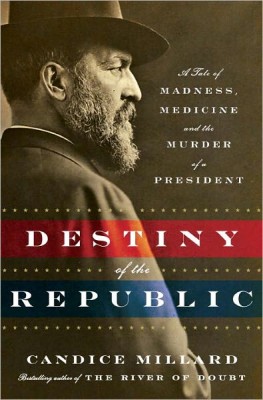
Destiny of the Republic: A Tale of Madness, Medicine and the Murder of a President by Candice Millard

Before reading Destiny of the Republic, all I really remembered about James A. Garfield was that he was one of the US Presidents, and that he was assassinated while in office. After reading Destiny of the Republic, I knew that Garfield was a man of extraordinary but not perfect character, a strong believer in the equality of Blacks,  never really wanted to be President of the United States, and died not from his assassin’s gunshot, but rather from medical ineptitude.

Funny, because the entire time I was reading this book, I kept thinking about how well it was written, how beautifully the various parts of the story were entwined, and how author Candice Millard (pictured) kept my attention even though she was conveying history, which can be very boring at the hands of the wrong person. Then when I started work on this review, I realized for the first time that Millard also wrote another of my favorite books, The River of Doubt: Theodore Roosevelt's Darkest Journey.

Destiny of the Republic also gives us such an in-depth tour through the insanity of Charles Guiteau (pictured), Garfield’s assassin, that I actually felt visceral anger and sympathy for him.  Although clearly insane, he was never properly cared for by society and thusly left to commit a senseless act that rocked a nation.

And then there was Dr. Doctor Bliss (no, that is not a typo nor redundant.) Dr. Bliss, whose first name was Doctor, swooped in at the train station just after Guiteau shot Garfield (pre-security for Presidents), and dictatorially and disastrously took command of Garfield’s medical care, seemingly for the fame it would bring him.  So forceful was Bliss’s dominance over Garfield’s medical care that, although other doctors including Garfield’s family doctor protested Bliss’s treatment decisions, he continued to treat Garfield literally to death. CLICK ON READ MORE BELOW...

Tuesday, December 6, 2011

One Hundred Things My Mother Taught Me A Million Times – Chapter 79

#79 – “Always wipe around plates to get the food dribbles off before you serve.”
(Making holiday ornaments with some of the grandkids!)
As you’ve heard me say many times, Mom was an enigma. She was a recluse and an extrovert; quiet and chatty; obsessed with her looks and a dedicated slob. And, as the saying goes, the apple doesn’t fall far from the tree. Let’s just say we’re eclectic. 

So what does this have to do with dribbles on plates? Well, mom would take a cake to a church social covered in a discarded plastic potato bag then (minus the bag) insist that the cake be carved into perfectly uniform pieces and served without a stray crumb on the plate. She would also boil borderline rancid meat in salt water to “purify” it and then prepare and serve it on china with the good silver. She was into food presentation before I ever even saw the word presentation used in proximity to food.

In these days of micro-portions and zero-fat dishes, I guess dribbles are a thing of the past, but when I was growing up it was all about creamy, drippy food and filling the plate to the rim. What is interesting is that although my generation was raised on lots of meat, potatoes, gravy, whole milk, sugar, real butter, eggs, and bread, and very few fresh vegetables, our parents weren’t obese and didn’t seem to die off prematurely. Furthermore, most everyone I grew up with is still alive and in reasonably good condition! In fact our lifespan has continued almost to the point of being ridiculous. After watching my mother turn into a zombie in a nursing home with 200 other zombies, I just do not want to live that long. Unfortunately, longevity is in my genes.

But back to wiping around plates to get the dribbles off--I still make gravy in our house, and beans, and stew, and soup, so dribbles happen, but I always wipe around the plate or bowl, just like mom taught me. After all, eclectic and cultured are not antonyms, and I do want to carry on the heritage of consistent inconsistency! 

The Gap Year by Sarah Bird

As I read Austinite Sarah Bird’s most recent novel The Gap Year, I  felt such a strong connection to her writing style and humor, and the setting, theme and characters of the book, I couldn’t help but wonder if she and I are twins separated at birth.  The two main characters of The Gap Year are Camille (Cam) Lightsey and her daughter Aubrey. Cam is a single mom who has given up on men, but has never gotten over her one true love, ex-husband Martin, the bohemian philosopher she fell in love with on a European backpacking trip. Unfortunately, Martin eventually became more interested in seeking his ultimate “being” then the “being” he sprouted in Cam's uterus, so he deserted her and the babe to hide in a cult for 16 years.

Cam raises Aubrey alone struggling to get her into the best schools, the cutest clothes and with the right kids. Absurdly, she’s also a hippy snob who thinks that people who send their kids to the best schools, dress them in designer labels and push them into cheerleading and football are poseurs. Cam is a Lactation Consultant living in a part of town where the word ‘lactation’ is never uttered, but she longs to live where dreadlocked, Birkenstocked, patchouli-reeking women gather in pocket parks, openly breast-feed their four-year olds, and share their hopes for world peace.

Surprise, surprise! Cam raises a daughter who is a conflicted rebel, which terrifies Cam because she sees herself in her daughter. Teen Aubrey is clueless about what she believes, but certain about what she doesn’t believe: anything that her mom does. She despises the popular-kid clicks and then falls in love with the captain of the football team. She resents her abandoning dad but lets him in her life via Facebook. The classic life-and-family struggles ensue and we see ourselves and find comfort in knowing that we’re not alone in the universe of family craziness. Click On Read More Below...

The Vanishing Act of Esme Lennox by Maggie O'Farrell

Iris, a young Scottish woman, is living a somewhat compromised and colorless life in Edinburgh, running a dress shop and in a relationship with a married man, when she receives news that she must now care for great-aunt Esme Lennox who has been hospitalized in a psychiatric hospital for 61 years – an aunt she didn’t even know existed! Now that’s a storyline that can make you snuggle down into a soft blanket and not want to surface until the mystery unravels!  Toss in a couple of other family twists, and you’ve got a page-turner.

Why was Esme committed to a mental institution when she was 16? Why is Iris just now finding out that her Alzheimer-afflicted (and pathologically cranky) grandmother, Kitty Lockhart, has a sister? What is Iris to do with Esme? What will Esme have to say about her life? What will happen when Esme and Kitty are reunited?

In the process of uncovering Esme’s story, Iris discovers much more than she could have imagined, and a heritage that brings new perspective to her life. The Vanishing Act of Esme Lennox reminded me of that Bible verse that goes something along the lines of, “The sins of the parents are visited upon the children.” 

In spite of the titillating storyline, I’m glad that I listened to this book rather than read it. I saw many reviews in which readers complained that the back-and-forth timeframe made the story difficult to follow and that the writing was not great. O'Farrell (pictured) is the author of a number of recognizable books, including, After You'd Gone," and The Hand That First Held Mine.

Although this book won’t make my list of “2011 Best Books” (stay tuned), it also won’t make the “worst of” list either. It was well worth the time.  Oh, and one more thing: When Esme and Kitty are reunited, what happens is, shall we say, chilling!