Sunday, July 24, 2011
One Hundred Things My Mother Taught Me a Million Times - Chapter 74
#74 - A sweet potato makes a beautiful, inexpensive, fast growing houseplant.
(Photo is of mom upon her college graduation - she was 40-years-old and had five kids when she graduated)
I love sweet potatoes and would probably eat them three times a week if the hubby shared that affection. Pan roasted with a little olive oil and a sprinkling of chopped rosemary, yum! I buy them often with the best of intentions, but in reality only cook them occasionally. Those that don’t get cooked sit in my veggie basket patiently waiting to please me, slowly loosing their moisture, their skin shriveling in seeming despair. I glance at them briefly, guiltily, like I’ve somehow let them down by not relishing their sweet, creamy being, and eventually toss them, all the while looking over my shoulder not making potato-eye contact. But, every now and then, I catch a glimpse of a root, reaching out, like a begging hand, and somehow know that this is one sweet potato I cannot get rid of because it reminds me of my mom.
Mom had a particular fondness for simple plants. I cannot pass by a stand of morning glories without tearing up, and I cannot throw away a sweet potato that has sprouted a root, because those were my mom’s two favorite plants. Morning glories grew prolifically out by mom’s back door, their purple and blue flowers trumpeting their vibrant beauty only briefly and yet gloriously in the cool of the morning.
Her sweet potato plants brought a deep green jungle of trailing vines and giant leaves into our home, adding a living breathing feeling to the otherwise inanimate furnishings. She would show me an aging sweet potato, pointing out the tiny roots reaching out of their eyes and say, “We’ll put this one in a jar.”
(Photo is of mom upon her college graduation - she was 40-years-old and had five kids when she graduated)
I love sweet potatoes and would probably eat them three times a week if the hubby shared that affection. Pan roasted with a little olive oil and a sprinkling of chopped rosemary, yum! I buy them often with the best of intentions, but in reality only cook them occasionally. Those that don’t get cooked sit in my veggie basket patiently waiting to please me, slowly loosing their moisture, their skin shriveling in seeming despair. I glance at them briefly, guiltily, like I’ve somehow let them down by not relishing their sweet, creamy being, and eventually toss them, all the while looking over my shoulder not making potato-eye contact. But, every now and then, I catch a glimpse of a root, reaching out, like a begging hand, and somehow know that this is one sweet potato I cannot get rid of because it reminds me of my mom.
Mom had a particular fondness for simple plants. I cannot pass by a stand of morning glories without tearing up, and I cannot throw away a sweet potato that has sprouted a root, because those were my mom’s two favorite plants. Morning glories grew prolifically out by mom’s back door, their purple and blue flowers trumpeting their vibrant beauty only briefly and yet gloriously in the cool of the morning.
Her sweet potato plants brought a deep green jungle of trailing vines and giant leaves into our home, adding a living breathing feeling to the otherwise inanimate furnishings. She would show me an aging sweet potato, pointing out the tiny roots reaching out of their eyes and say, “We’ll put this one in a jar.”
Emily and Einstein by Linda Francis Lee
I struggled to come up with an honest description of Emily and Einstein by Linda Francis Lee because I sort of liked it, but was also sort of mad at it because it didn’t pan out to be everything I wanted it to be (although I would also struggle to tell you why). So here you go. It was a sweet little book.Emily is a too nice gal from modest origins married to Sandy, a despicable guy from old money. A cliché. Sandy steps off the curb in New York City where they live, gets hit by a bus, dies and comes back as an injured dog that is sent to a pound where he is nursed back to health and eventually adopted by a volunteer at the pound, his wife, Emily. Not a cliché, although it seems everyone is writing dog books. Who doesn’t have a special place in their heart for unconditionally loving canines? The theme of a husband dying and coming back as a dog, Einstein, was titillating, but Sandy/Einstein was such a terrible person and dog, I eventually found myself wanting him to run out into the street again.
The apple doesn’t fall far from the tree, and Sandy/Einstein’s “e-ville” mom hardly waits for the dirt to settle on her son’s grave before she begins eviction proceedings to get her daughter-in-law thrown out of her son’s apartment at the famous Dakota building. OMG, I can’t tell you how any times I’ve stood outside the Dakota and imagined myself living there, in an apartment overlooking Central Park of course.
Sandy has come back as a dog because, in some weird supernatural situation I could never seem to understand, he must make amends to Emily for being such a shit before he can go to heaven or wherever. That whole theme is never explained to my satisfaction, or perhaps I zoned out when author, Lee (photo below), explained.
My Editor – Deborah Fondren
I would like to take a few lines to thank my editor and best friend, Deborah Fondren, who gamely puts up with my weekly, and sometimes painful attempts at grammar and punctuation. Believe me when I say that any slaughter of the Kings English in my blogging is probably due to my diddling with Deb’s edits.
Thanks to Susan Eason too for stepping in as a substitute editor when Deb is busy, away from her computer, or justifiably ignoring me!
Photo was taken in San Miguel Mexico in 2007, and is my favorite photo of us because it is flattering to us both! We have been such good friends for so long that a few people have accused us of being lesbian lovers, which if we weren't such devoted heterosexuals, could actually be true (gag reflex engaged). I love her (platonically) that much.
Thanks to Susan Eason too for stepping in as a substitute editor when Deb is busy, away from her computer, or justifiably ignoring me!
Photo was taken in San Miguel Mexico in 2007, and is my favorite photo of us because it is flattering to us both! We have been such good friends for so long that a few people have accused us of being lesbian lovers, which if we weren't such devoted heterosexuals, could actually be true (gag reflex engaged). I love her (platonically) that much.
Tuesday, July 19, 2011
Area 51: An Uncensored History of America's Top Secret Military Base by Annie Jacobsen
What is more disturbing than aliens in Roswell? The “big reveal” at the end of Annie Jacobsen’s book, Area 51: An Uncensored History of America's Top Secret Military Base!
Let me preface my review of Area 51 by saying that I am not a conspiracy theorists, I do not believe aliens from another planet have landed in Roswell, New Mexico (or anywhere else on Earth), and I am not particularly enthralled with government cover-ups. I am, however, very curious about just about everything, which is what led me to read Area 51.
Ever wonder why you can’t seem to get your teeth as white as the “whitening strips” promise? Ever wonder why your third cousin removed says, “like” a lot? According to author Annie Jacobsen, your permanently yellow teeth and your cousin’s annoying linguistics are both because of Area 51. Not really, but by the time I finished reading Area 51, it seemed as though there were less then seven degrees of separation between every event and circumstance in the world, and Area 51.
Three Cups of Deceit: How Greg Mortenson, Humanitarian Hero, Lost His Way by Jon Krakauer
Nobody likes a tattletale. On the other hand, even depressing circumspection is good.
Jon Krakauer, whose books Into Thin Air and Into The Wild I loved, has stirred up a hornet’s nest, al la Oprah Winfrey/James Frey (A Thousand Little Pieces). In Three Cups of Deceit, he provides details and “evidence” that Greg Mortenson’s book, Three Cups of Tea, is full of lies and exaggerations, and that Mortenson has exploited the non-profit he establish, Central Asia Institute and its donors, for his own personal gain.
Three Cups of Tea is Mortenson’s huge best seller about how when lost in Afghanistan after trying unsuccessfully to climb K2 (second highest peak in the Himalayas), he ends up in a village where he is taken in and cared for. In appreciation, he pledges to return and build schools all over Afghanistan, which he does, via the non-profit he establishes, Central Asia Institute.
Three Cups of Deceit is Jon Krakauer’s claim that Three Cups of Tea is 90% false, Central Asia Institute is poorly run, and Mortenson is a deceitful opportunist.
Monday, July 4, 2011
The Killer Inside Me by Jim Thompson
Researching for something to read during an upcoming weekend in Marfa, I googled “the best psychological thrillers ever” and The Killer Inside Me popped up in the top three of every list I found.
The Killer Inside Me is about the chillingly sociopathic Lou Ford, deputy sheriff in a small Texas town in the 1950s, who has a secret need for sadomasochistic sex with compliant women. And he really must kill the people he loves, and anyone who gets in his way, but in disturbingly interesting ways. The fact that I, and many others, enjoyed this book so much is more than a little unsettling. I think (hope) it was the exceptional writing that was the book’s hook and the interesting perspective provided through the first person telling of the story, but I also think that humans have an innate curiosity about things they would never do.
Just to give you an idea of how “rough” this book is (as my mom would say), it and the movie have been described as “misogynist hate-porn with a fancy wrapper.” The movie has even been criticized in Europe where just about anything goes. Hitchcock’s shower stabbing scene in Psycho, which is pretty much the same hate-woman-kill theme as in The Killer Inside Me, doesn’t seem as brutal as what is portrayed by Thompson.
The Killer Inside Me is about the chillingly sociopathic Lou Ford, deputy sheriff in a small Texas town in the 1950s, who has a secret need for sadomasochistic sex with compliant women. And he really must kill the people he loves, and anyone who gets in his way, but in disturbingly interesting ways. The fact that I, and many others, enjoyed this book so much is more than a little unsettling. I think (hope) it was the exceptional writing that was the book’s hook and the interesting perspective provided through the first person telling of the story, but I also think that humans have an innate curiosity about things they would never do.
Just to give you an idea of how “rough” this book is (as my mom would say), it and the movie have been described as “misogynist hate-porn with a fancy wrapper.” The movie has even been criticized in Europe where just about anything goes. Hitchcock’s shower stabbing scene in Psycho, which is pretty much the same hate-woman-kill theme as in The Killer Inside Me, doesn’t seem as brutal as what is portrayed by Thompson.

One Hundred Things My Mother Taught Me a Million Times - Chapter 73
(Photo is of my son Colt, his partner Heather, and her two daughters, Taylor and Gracie. There's also a baby bump on Heather that is my newest granddaughter, scheduled to arrive in early October!)
#73 - When blankets get old and thin, patch them together.
If I had a backbone I would have buried my mother with an old blue blanket she loved and had patched so many times that it was as soft as a baby blanket. However, I couldn’t seem to get her in a coffin and in the ground fast enough. This is a very emotional confession for me, and I knew it would be when I saw #73 come up on the list of things mom taught me a million times. The reason I was in such a hurry to bury my mom was because it was so very painful to see her dead, and I’d been looking at her dead for a year. Not physically dead, but mentally – or so it seemed. She progressively lost her ability to talk, to recognize her family, to make eye contact, or to do anything that seemed familiar. It just didn’t feel like she was “in there,” and I was pretty convinced she wasn’t. But let’s talk about patching blankets, because I really don’t want to cry.
Sunday, June 26, 2011
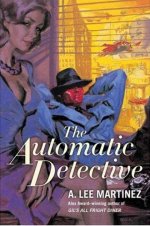
The Automatic Detective by A. Lee Martinez
I have a huge crush on Mack Megaton, a seven-foot tall robot with a free will glitch who becomes a reluctant detective and refers to humans as “squishy biologicals.” Mack is the main character in the wittiest book I’ve read this year, and possibly the best book I’ve read since The Help, which is saying a lot since The Help is a literary blockbuster and The Automatic Detective is sci-fi pulp fiction.
Apparently this theme isn’t original, i.e., Isaac Asimov's Caves of Steel, and I-Robot among others, but it’s new to me, and I loved it! Just imagine a hard-boiled Dashiell Hammett or Raymond Chandler detective mystery, set in a bizarre retro near-future full of mutants, aliens from an undisclosed universe, and robots. I know that doesn’t make sense, but it does in the book. I wouldn’t have picked this book if I’d known what it was about, but people were raving about it so I decided to give it a try, and I’m glad I did.
Mack Megaton, seeking a more human existence and citizenship in a world oozing biological nastiness and mutant creatures, gets dragged into the rescue of a human family of friends who have been kidnapped in a bizarre conspiracy. Forget about that though as the story is secondary to the hilarious dialogue and whacky characters. I loved Jung, Mack’s sidekick, a gorilla-like human who loves to read Jane Austen. And get this, Mack is all man, but he’s not sexual. There are sexy women characters and seductions, but there is no sex, zero, zip, nada.
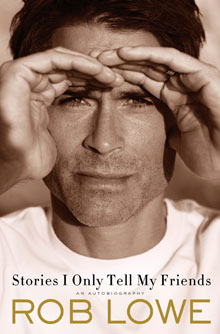
Stories I Only Tell My Friends: An Autobiography by Rob Lowe
I didn’t want to read Rob Lowe’s autobiography, Stories I Only Tell My Friends, and I sure didn’t want to like it, but I did both. When I told my hubby who was equally disinterested in Rob Lowe that I’d really enjoyed Lowe’s book, he said, “What was so good about it?” I effortlessly ticked off the following:
1. Lowe apparently wrote Stories I Only Tell My Friends, himself, and he did a good job. His mother was a prolific, yet seldom published writer, and his family ran in a pretty educated circle. This literate foundation provided a more apt and cultivated narrative than I expected. No doubt he has a good editor too. Plus Jodie Foster is one of his best friends, and I doubt she suffers dummies.
2. I listened to the audio version of the book, and was entertained and amused by Lowe's exceptional voice impersonations of the many recognizable characters he talked about in his book. The way he introduced his famous friends was fun too - almost like a game of charades. He would tell a little bit of a story about someone, tossing out clues, then came the big reveal. I had fun trying to guess who he was introducing based on a clue like, “We both took our trash out on Tuesdays, and he would fix me with that look and say, ‘I’ll be back.’” Well, not that obvious, but you get the picture (no pun intended).
1. Lowe apparently wrote Stories I Only Tell My Friends, himself, and he did a good job. His mother was a prolific, yet seldom published writer, and his family ran in a pretty educated circle. This literate foundation provided a more apt and cultivated narrative than I expected. No doubt he has a good editor too. Plus Jodie Foster is one of his best friends, and I doubt she suffers dummies.
2. I listened to the audio version of the book, and was entertained and amused by Lowe's exceptional voice impersonations of the many recognizable characters he talked about in his book. The way he introduced his famous friends was fun too - almost like a game of charades. He would tell a little bit of a story about someone, tossing out clues, then came the big reveal. I had fun trying to guess who he was introducing based on a clue like, “We both took our trash out on Tuesdays, and he would fix me with that look and say, ‘I’ll be back.’” Well, not that obvious, but you get the picture (no pun intended).
Saturday, June 11, 2011
One Hundred Things My Mother Taught Me A Million Times – Chapter 72
#72 – “Use Palmolive dish soap to shampoo your hair. It is less expensive than shampoo, and makes your hair really shine.”
Apparently Palmolive dish soap was pretty cheap when I was growing up as we always had it around. The only reason we didn't use Tide, which was even cheaper, for washing our hair and dishes in addition to our clothing, was because it burned your skin!
Mom was frugal, but not just because she grew up in the Great Depression, or because that was the way she was raised. After my dad died and we sold everything to pay off the loans on the road construction equipment (dad owned a fairly lucrative construction company), we were left with no home, an old car, mom’s $300 a month teaching salary, and her undeterred desire to groom me for marriage to someone who could give me a “better” life - or at least to become a strong independent woman capable of giving myself a better life. If washing our hair with dishwashing soap could save a few pennies to buy me a prettier dress, dance lessons, or books to “expand my horizons,” then that’s the way it would be.
When you are a kid you are oblivious to the sacrifices made by your parents, their motives, the what’s and why’s. I recall a child psychologist telling me one time that my kids were more concerned about what time their favorite cartoon was coming on then whether or not I was with them 24-7 - which I had a great deal of difficulty accepting.
I recall agonizing for three days about having to tell my 8-year-old daughter she couldn’t go swimming because of an ear infection, but that her brothers could. When I told an old friend that I thought I shouldn’t let the boys swim either, he said to me, “You must teach your children to accept disappointment. If you fix everything for them, and they go out into the world and you’re not there to fix things, they are at a disadvantage.” I took his advice. My daughter cried for 5 minutes and got over it.
Bossypants by Tina Fey
Although I didn’t know much about Tina Fey before I read her book, Bossypants, what I think I know about her now is that she and I hide our insecurities behind humor. When going though the life-defining time of Junior High and High School, I was never pretty, smart or nice enough to be cheerleader, valedictorian, or most popular (my generation’s Nobel Prizes of Teenage-dom), so I fell back to baton twirler, clever gal, and class clown. Some of my classmates are probably thinking, “I don’t remember her being clever or funny!” But by gaud, no one can take my twirling medals away from me! So back to Tina Fey and her hilarious and interesting book, Bossypants.
Ever wonder where the fancy pants, smarty pants, bossy pants, linguistic formulation came from? Really? OK. Never mind. Let’s (I’ll) talk about Bossypants.
For those of you similarly unfamiliar with Tina Fey, she is (in her words), “a wide-hipped sarcastic Greek girl." She is also the former head writer for Saturday Night Live, and currently the star and executive producer of the Emmy-winning TV sitcom, "30 Rock.” Bossypants is her subtly deep book about her evolution from middle-class Pennsylvanian misfit to iconic liberal female humorist of the 2000’s. Do conservatives even have humorists?
When I first started Bossypants, I thought, well, this is funny, but it is really just a Tina Fey monologue, which is a ridiculous observation since that’s the whole point of biographies, but it felt like a stand-up comedy routine rather than your typical biography. What I soon came to realize is that Fey is really just too smart to do a straight-up story of her life. She has to weave her comedic magic by hiding her honesty, wisdom, politics and stunning intellect like Easter eggs. Granted, they were hidden like you would hide eggs from a 3-year-old, but that was the coolest part. It wasn’t in your face, but you also didn’t have to work for it. Click on Read More Below...
Ever wonder where the fancy pants, smarty pants, bossy pants, linguistic formulation came from? Really? OK. Never mind. Let’s (I’ll) talk about Bossypants.
For those of you similarly unfamiliar with Tina Fey, she is (in her words), “a wide-hipped sarcastic Greek girl." She is also the former head writer for Saturday Night Live, and currently the star and executive producer of the Emmy-winning TV sitcom, "30 Rock.” Bossypants is her subtly deep book about her evolution from middle-class Pennsylvanian misfit to iconic liberal female humorist of the 2000’s. Do conservatives even have humorists?
When I first started Bossypants, I thought, well, this is funny, but it is really just a Tina Fey monologue, which is a ridiculous observation since that’s the whole point of biographies, but it felt like a stand-up comedy routine rather than your typical biography. What I soon came to realize is that Fey is really just too smart to do a straight-up story of her life. She has to weave her comedic magic by hiding her honesty, wisdom, politics and stunning intellect like Easter eggs. Granted, they were hidden like you would hide eggs from a 3-year-old, but that was the coolest part. It wasn’t in your face, but you also didn’t have to work for it. Click on Read More Below...
The Legacy Continues
SueAnn Wade-Crouse - Miss Iraan, Texas Baby 1949 and Miss Iraan 1966.
Mini Miss Texas, 2011, Granddaughter, Khloe Noelke.
Tuesday, May 31, 2011
Dim Sum for Dummies
Sunday the hubby and I joined Benita and Don Giller for dim sum at Chinatown, and spent amazingly little on a sumptuous and fun meal. Since it had been too many years since I “dim summed,” I performed a little pre-research, hoping to avoid culinary faux pas. What I found was pretty interesting (to me at least), so of course I had to blog about it. Dim sum, which literally translates to "touch the heart" or “point of the heart” (depending on the source), is a Cantonese term for a type of Chinese dish that involves small individual portions of food usually served in a small steamer basket or on a small plate. Dim sum is also inextricably tied to the experience of "yumcha" or the drinking of tea.
The drinking of tea is as important to dim sum as the food. Thank gaud I found this out in advance. I would have probably ordered a diet coke! It is also important to pour tea for others during dim sum before filling one's own cup, which I found to be a particularly civil and sweet ritual. And a custom unique to the Cantonese is to thank the person pouring the tea by tapping the bent index finger if you are single, or by tapping both the index and middle finger if you are married, both of which symbolize 'bowing' to them.
Writing Your Life As A Woman
This is gal-friend, Dean Lofton's writing class.
I hope you'll consider joining. Dean's one sharp cookie and I think you'll enjoy...
A class taught in the style of journal writing workshops…
guides women to write their stories and discover their voice…
gentle encouragement in a non-academic, creative environment…
no writing experience necessary...
Summer classes:
Tuesdays, June 7 - 28, 7:00 - 9:00 pm
and
Tuesdays, July 5 - 26, 7:00 - 9:00 pm
4-week sessions meet at
Opal Divine's, 3601 S. Congress
(Penn Field, in the game room)
$70 for 4 weeks, $20 drop-in.
Dean Lofton
Writer, Publicist, Creative Strategy
Austin, Texas
512.636.1346
Writer, Publicist, Creative Strategy
Austin, Texas
512.636.1346
Look Again by Lisa Scottoline
My Memorial Day weekend goal was to read a book I wouldn’t pick out myself but which came highly recommended by someone whose opinion I respect. I achieved my goal and grudgingly enjoyed Look Again by Lisa Scottoline. You’re probably wondering what that means, or not.
The email from said-respected friend said, “Have you read, Look Again by Lisa Scottoline? If not, it's a good un' - lots of twists, a super bad guy, and a gut wrenching ethical and moral decision.” Based on that snappy one-sentence inducement, I bit and I’m glad I did, sort of.
Could I get any wishy-washier? Yes, but first let’s get the obligatory, “tell what it's about without a spoiler,” out of the way. One of those “Have You Seen This Kid” flyers arrives in single mom, Ellen's, mail. The age-progressed picture on the flyer looks almost exactly like her three-year-old adopted son. Things then get weird. And there’s an exciting ending. OK, back to wishy-washy:
Monday, May 30, 2011
One Hundred Things My Mother Taught Me A Million Times – Chapter 71
# 71 - “Don’t wear glasses, they make your eyes weak.”
When writing about the one hundred things mom taught me a million times I usually research the topic de jour, and almost always find surprising scientific research supporting mom’s seemingly off-the-wall beliefs. And then there are those days when, after looking at the Google links, I feel like I’ve strayed into the Twilight Zone! Today was one of those. Click on arrow below...
When I Googled “wearing glasses makes your eyes weak,” 83 pages of mostly wacko-to-the extreme info popped up. For example: One site claims “glasses and contact lens are merely a crutch for your eyes.” I swear, mom always said glasses are just a crutch! The site further claims, “Your eyes will therefore become lazy and weaker with time.” Mom said that too! This site, however, was selling “pinhole glasses” that supposedly “exercise” your eyes to make them stronger. I ask you. Would you ride in a car with a driver wearing these?
Fearless Women, Fearless Vision
Mary Ann Halpin is compiling the next edition of her wildly popular book, Fearless Women, Fearless Vision, and is accepting applications for inclusion.
If you are interested in being in the next edition (you should be), please click here, and mention my friends name, fearless woman, Patti DeNucci.
If you have questions, please contact Patti by clicking here. She says that being in this book has brought many positive spinoffs.
Click on the arrow below for the full story...
My Weekend in Marfa, Marathon and Alpine

Saturday morning we savored brunch at Cochineal (photo left), visited the Chinati Foundation, Ballroom Marfa, inde/jacobs and several other galleries, then siesta-ed in the warm pm. As happy hour approached, we drove to Marathon for drinky-poos at the Gage Hotel White Buffalo bar.
While in Marathon we visited Eve’s Garden B and B (below, left) and I was reminded of how much I love that place and want to stay there again soon. Although you can’t tell from the outside, it really is the Garden of Eden on the inside, and I love the owner Kate, who is always so generous with her time and prepares the yummiest organic breakfast!
In the Garden of Beasts: Love, Terror, and an American Family in Hitler's Berlin by Eric Larson

Ever wondered what life was like in Berlin right before Teutonic-twit Hitler’s shit hit the fan?
Ever wonder why the German people so enthusiastically embraced the Nazi “let’s get even” party?
Ever wonder why it took so long for America to wake up and smell the Jewish exterminations?
Me too. I think I gained a clearer insight into these issues reading the Wiki Adolph Hitler page, but Eric Larson’s new book, In the Garden of Beasts (released May 10) was wunderbar!
So what was so wonderful about In the Garden of Beasts? Larson’s writing, of course. The man’s a master storyteller. But two of Larson’s other books are a little more “digestible.” If you haven’t read Isaac’s Storm (1900 Galveston hurricane) and Devil in the White City (1893 Chicago World’s Fair), get to Amazon.com immediately! Was it the intriguing story of what it was like to live in Berlin during the rise of Hitler’s bile? Well, yes - it was such a provocative and politically tumultuous time. The book title In the Garden of the Beasts refers to Berlin’s central park, the Tiergarten, which literally translates as “Garden of Beasts.” It’s an apt symbol of the beautiful city and country preyed upon by the beast of Nazism. The Tiergarten was also one of the only places people could converse in privacy.
Sunday, May 29, 2011
Genghis Khan and the Making of the Modern World by Jack Weatherford
First, let us get one thing straight: Genghis Khan is not pronounced Gingus. It is either pronounced Jingus Kahn (per the audio version of Jack Weatherford’s book) or Chingis Hahn (per Wiki). Apparently how to pronounce Genghis Khan’s name, as well as most information about this famous 13th century character, is highly debatable. Genghis Khan in traditional Mongolian writing (right).
If it hadn’t been for the mysteriously named The Secret History of the Mongols (author unknown and the oldest surviving Mongolian literary work), we would know relatively little about Genghis Kahn who was originally named Temujin. As with any historical book, however, comes the inevitable prejudice of the writer, the bending of truth, and the resulting foaming-at-the-mouth scholars challenging its veracity.
Unburdened by a scholarly point of reference, I read Genghis Khan and the Making of the Modern World as “gospel” and enjoyed the hound-dog outa’ it. The more history I read, the more evidence I find that our species is just a fight looking for a place to happen. And sure enough, Genghis Kahn (nee Temijin) began life kidnapped in a warring raid and pretty much went on to make waging war his life’s work.
Sunday, May 8, 2011
All the Time in the World' by E.L. Doctorow
Author E.L. Doctorow (accent on first syllable) may have All the Time in The World, but I don’t. I listened to the audible version of this book during a recent drive to Alpine, and if it hadn’t been on my iPhone, I would have thrown it out the window. Apparently the NY Times reviewer Jess Row and I are the only people in the world who don’t love this book, which is a collection of new and previously published short stories. Row said it well: "A great short story has to function like a black hole, demanding our entire attention, drawing all available light into itself, but Doctorow’s energies are too diffuse and variegated to achieve that effect often."
In a nutshell, All The Time In The World is stream of consciousness writing about despicable characters. Doctorow even admits, "You write to find out what you're writing." One reviewer called it “willfully obscure.”
My sensitivities were put on high alert when in the preface Doctorow said he didn’t believe "…stories collected in a volume have to have a common mark, or tracer, to relate to one another." Then he said he didn’t believe that they needed to have a resolution or an ending, which sounded like a warning, and it was. Re: despicable characters – granted, characters don’t have to be likable, but I do think that you have to care about who they are, what they’re doing and why. I didn’t. Well, except for the serial husband killer and her accomplice son. They were interesting, in a villainous sense. Click on Read More Below...
In a nutshell, All The Time In The World is stream of consciousness writing about despicable characters. Doctorow even admits, "You write to find out what you're writing." One reviewer called it “willfully obscure.”
My sensitivities were put on high alert when in the preface Doctorow said he didn’t believe "…stories collected in a volume have to have a common mark, or tracer, to relate to one another." Then he said he didn’t believe that they needed to have a resolution or an ending, which sounded like a warning, and it was. Re: despicable characters – granted, characters don’t have to be likable, but I do think that you have to care about who they are, what they’re doing and why. I didn’t. Well, except for the serial husband killer and her accomplice son. They were interesting, in a villainous sense. Click on Read More Below...
One Hundred Things My Mother Taught Me A Million Times – Chapter 70
#70 – “Always put on lipstick so you won’t look so washed out.”
(Photo is of The Book Goddesses, clockwise, Debbie Kern, Loralee Martin, Me, Cathy Crabtree, Cathy Weaver, Debbie Tate and Sandra Martin.)
Anyone who knows me knows that I take this one of one hundred things very seriously. You won’t catch me without lipstick very often. It’s sort of a defining characteristic: my trademark. When I told an old boyfriend one time that I bet the first thing that attracted him to me was my boobs, his reply was, “Actually, they were the second and third things. The first was your lips.”
Mom was never without lipstick either, although her choice of color was decidedly more conservative then mine. I lean towards the “Look at Me” reds and “I’m A Hot Bitch” orange. I think there are some self-esteem issues there, but I don’t want to talk about that. I want to talk about lipstick.
I loooove lipstick! I’m the Imelda Marcos of lipstick. I just did a quick and dirty count to see how many tubes of lipstick I had in my makeup drawer, purse and car, and was rather horrified to discover there were only 32! Of course I did do a major purge a couple of weeks ago, taking cast offs to Goodwill.
Aside from the emotional investment, my financial investment in lipstick is also substantial. I figure I buy 2-3 tubes of CoverGirl Outlast All Day Lipcolor (my fave) per month, and at $10 a pop that’s about $360 a year on lipstick. However, I used to wear Chanel Rouge Hydrabase Crème Lipstick, went through 2-3 tubes per month, and those cost $30 a tube or $1,000 per year. Just for giggles, lets calculate a lifetime investment: $50,000! Holy Gloss, that’s just obscene! But then, I got to be me. Click on Read More Below...
(Photo is of The Book Goddesses, clockwise, Debbie Kern, Loralee Martin, Me, Cathy Crabtree, Cathy Weaver, Debbie Tate and Sandra Martin.)
Anyone who knows me knows that I take this one of one hundred things very seriously. You won’t catch me without lipstick very often. It’s sort of a defining characteristic: my trademark. When I told an old boyfriend one time that I bet the first thing that attracted him to me was my boobs, his reply was, “Actually, they were the second and third things. The first was your lips.”
Mom was never without lipstick either, although her choice of color was decidedly more conservative then mine. I lean towards the “Look at Me” reds and “I’m A Hot Bitch” orange. I think there are some self-esteem issues there, but I don’t want to talk about that. I want to talk about lipstick.
I loooove lipstick! I’m the Imelda Marcos of lipstick. I just did a quick and dirty count to see how many tubes of lipstick I had in my makeup drawer, purse and car, and was rather horrified to discover there were only 32! Of course I did do a major purge a couple of weeks ago, taking cast offs to Goodwill.
Aside from the emotional investment, my financial investment in lipstick is also substantial. I figure I buy 2-3 tubes of CoverGirl Outlast All Day Lipcolor (my fave) per month, and at $10 a pop that’s about $360 a year on lipstick. However, I used to wear Chanel Rouge Hydrabase Crème Lipstick, went through 2-3 tubes per month, and those cost $30 a tube or $1,000 per year. Just for giggles, lets calculate a lifetime investment: $50,000! Holy Gloss, that’s just obscene! But then, I got to be me. Click on Read More Below...
The Uncoupling by Meg Wolitzer
Greek playwright Aristophanes wrote a clever and humorous play in 411 BC about a one-woman mission to end the seemingly endless Peloponnesian War by convincing all the women to withhold sex from their husbands and boyfriends until the war ended. Lysistrata was the woman, the name of the play, and a defining character in my life.
In 1966 I was a just a little country bumpkin raised in a male-dominated west Texas culture. I enrolled in Drama 101 at Dallas County Junior College and after reading Lysistrata for class I felt I’d seen the burning bush. Women had power! But I didn’t see it as sexual power. I saw it as intellectual power, and that made me feel breathlessly powerful.
When I read that The Uncoupling by Meg Wolitzer was about a community of women in small-town New Jersey who lose their sexual desire, simultaneously to a high school drama class staging of Lysistrata, I snapped it up wondering where in the world Wolitzer would take that theme! Click on Read More Below...
The Emperor of All Maladies: A Biography of Cancer by Siddhartha Mukherjee
I’ll bet when author Siddhartha Mukherjee first sent his manuscript for this book to Simon & Shuster the title was A Biography of Cancer. Whoever came up with The Emperor of All Maladies probably got a huge raise! By any name, it is a very detailed history of a disease that has evaded cure, seemingly since the beginning of time. Even now, in spite of billions of dollars in research and treatment, “the big C” is still our most feared boogieman. I’m usually all over anything remotely related to science, but this book was much like the disease– complex, unrelenting and exhausting!
Publishers Weekly called it “a sweeping epic of obsession,” and that’s on point. I could only read for 20-30 minutes at a sitting without my brain feeling like it was going to spontaneously combust. When I just couldn’t absorb another minute, I’d switch to something lite, like The Biography of Genghis Khan.
I did learn a lot more about the horrendous evolution of mastectomies and chemotherapy; how the immergence of AIDS was intertwined with the fight against cancer; the battles between the treatment and prevention camps; and the never ending “miracle cure” bunny trails. I also learned that Dr. Sidney Farber, Charles E. Dana and Mary Lasker established the first clinic that specialized in cancer care and research, the Dana Farber Cancer Center in Boston, and spent their lives chasing down this “serial killer”. Click on Read More Below...
Subscribe to:
Comments (Atom)