The Grownup: A Story by Gillian Flynn
The
Grownup is about a woman who
seems smart enough to run a Fortune 500 company, yet gives hand jobs and “reads
auras” in the back of a fortune teller’s shop. Said improbable handmaiden/aura
reader latches onto a wealthy woman desperately seeking someone to “purify” her
haunted Victorian house (of course) and deal with her spooky stepson (of
course). There are plot twists (of course) and then it ends. Yes, I’m giving
this one booktitude (made up word, but you get it).
Every time a new
literary idol, like Gillian Flynn with Gone Girl, surfaces so too do
their other writings, as publishers rush to capitalize on starry-eyed
fans. Such is the case with
Flynn’s micro-book (really a short story) The Grownup. For sure Flynn
can create complicated, charismatic characters and story scenarios that make
you flip pages like the wind, but Gone Girl is her only book so far that
has reached the literary holy grail that separates prodigy
from pupil - great story, great characters, great ending. Don’t get me wrong, you’ll probably
enjoy the hour it takes to read The Grownup (and it did win a 2015 Edgar
Award for best short story), but it, like Flynn’s other books, Sharp Objects
and Dark Places, doesn’t measure up. Hey, I didn’t set the bar.
Flynn did.
It Was Me All Along by Andie Mitchell
Anyone who soothes
their soul with food will relate to It Was Me All Along about growing up
in a particularly fractured family where food was the babysitter, the hug, the
love. Not unlike many books written about conquering emotional eating, Mitchell
takes us through the common thresholds of her life, all alternately defined by
eating: shame, unhealthy and heroic efforts to lose weight, acceptance,
and of course the inevitable triumph. Does anybody write about continued
overeating failure?
But what makes Mitchell’s book better than average is
that she is likable. It Was Me All Along is a "comfortable", unchallenging book, but if you want to read a book that is a more interesting examination of the issue of conquering overeating, read Big Brother: A Novel by Lionel Shriver (fiction).
Pirate Hunters by Robert Kurson
After receiving so many blank stares from my
enthusiastic recommendation of Robert Kurson’s first book Shadow Divers, about two deep sea divers’ discovery of a shipwrecked WWII German
U-Boat, I was thrilled when I received an email saying,
“I saw on your blog that Shadow Divers was one of your favorite books. I
loved it too.” That email came from Sarah Bird (Above the East China Sea) and
launched a friendship. So when I saw that Kurson had written a new book, my
heart did a little tap dance and I immediately texted Sarah.
What’s not to like about anything that contains
the word “pirate?” And sure enough in Pirate Hunters Kurson delivers a
dashing tale of intrigue, gold, and modern-day pirates. He does this by
typically and appealingly blending history and process (which in the wrong
hands could be boring) in ways that keep you on edge, pleasantly anxious, and
convinced that on the very next page you’ll see the words, “we found it.” And
did they? Well, what do you think? Take a walk on the Pirate side! Read it.
The Crossing by Michael
Connelly
I can forgo nearly every recurring
character-series book after about the third, but I can’t resist Michael
Connelly’s Harry Bosch and Harry Haller series. I wouldn’t characterize
any of Connelly’s books as fabulous, but they are consistently good
intellectual who-done-its, and The Crossing is no exception. The
bonus of reading The Crossing is that its plot includes both
Harry Bosch (a brutal but lovable-and-means-well rule-breaking cop forced into
early retirement), and Harry Haller (a shrewd “good guy” criminal defense
attorney), who happen to be half-brothers and are usually on opposite ends of a
crime.
Haller has signed up to defend an otherwise unsavory character he
believes is innocent of a particular murder, and he needs Bosch’s help. Haller
can barely stomach the idea of working on the “dark side,” but he gets sucked
in and so do we.
Connelly may not make
you swoon, but he always entertains. Need a good summer beach read? Here’s your
sign.
Lab Girl by Hope Jahren
Jahren, a professor of geobiology at the
University of Hawaii, and a self-confessed workaholic and manic-depressive,
says she was raised in a Minnesota family of Norwegians who forged and
reinforced daily “vast emotional distances between the individual members of
the family…. going days without anything to say to each other.” So the solitary
life of a scientist became her home and her life. And yet, this introvert
spills it all in poetic, philosophical allegory for us to examine and ponder.
Although some of her most potent narrative is
about plants, it’s her self-observations that take our breath away and make us
introspective. On plants: “A cactus doesn’t live in
the desert because it likes the desert; it lives there because the desert hasn’t killed it yet". On being a scientist she describes herself as
an ant: “Driven to find and carry single dead needles, one after the
other, all the way across the forest and then add them one by one by one to a
pile so massive that I can only fully imagine one small corner of
it…insufficient and anonymous, but stronger than I look and part of something that is much bigger than I am”. On life she says: “Each beginning is the end of a waiting. We are each given
exactly one chance to be. Each of us is both impossible and inevitable. Every replete tree
was first a seed that waited.” On having children: “I have learned that raising a child is essentially one long,
slow agony of letting go.”
As a fidgety dreamer never satisfied with the
status quo, I found her plodding, relatively uneventful life soothing and
alluring. As a writer always seeking the right words, I found her eloquence
enviable. Read Lab Girl.
Badluck Way
- A Year on the Ragged Edge of the West by Bryce Andrews
You would
think, having spent 12 years owning and living on a large Texas working ranch,
then managing a small dude ranch in New Mexico for a year, I would have gotten
over romanticizing the cowboy/cowgirl life. But I haven’t. So when I saw a
Kirkus Reviews description of Badluck Way as a “A coming-of-age memoir
that illuminates the pleasures and problems of running a conservation-oriented
sheep and cattle ranch,” I bit.
Bryce Andrews
is a young Washington state urbanite raised in a family of music and museum
professionals. But he too had the cowboy itch so when the opportunity came
along for him to work on a ranch in southwest Montana, just across the border
from Yellowstone Park, he takes a year out of college to see what ranching is
all about. He learns it’s a lot of hard work and hard choices – like killing
beautiful wild animals that are killing the stock of your livelihood for
example. Being the only employee, isolated on a vast and lonely, wind-swept
prairie, he also learns a lot about himself. Lucky for us, Andrews can write
beautifully, so we are treated to lines like: “It occurred to me that I had
achieved a rare thing: I was living at the center of my heart’s geography. And
I knew it.” If this quote appeals to you, or if you’ve also romanticized the
cowboy/cowgirl life, you will probably enjoy Badluck Way.
Eruption:
the Untold Story by Steve Olson
I suspect
we’ve all heard the story of the Mount St. Helen’s volcanic eruption many times
from many perspectives. But this version, as told by Steve Olson, goes beyond
the fact that it was one of the largest eruptions in human history and killed
57 people. Olson gives us the history and politics leading up to the eruption,
and which significantly endangered many more people than it should have. For
example, the logging industry, which gambled with the lives of its workers, and
the political pressure they placed on elected officials to keep a lid on the
impending danger. Also, volcanologists knew far in advance that Mount St. Helen
was going to blow and yet campers, including children, were allowed to remain
on the mountain. Some died or were severely burned by the volcanic ash and
barely escaped with their lives. Most of all, Eruption makes it
frighteningly clear that in spite of all our science and preparedness, we are
at the mercy of our natural world, and we are not prepared. Don’t get me wrong,
the purpose of this book isn’t sensationalism, it is educational, and it is
well written.
The Long
Shadow of Small Ghosts: Murder and Memory in an American City by Laura Tillman
When I
googled the names of John Allen Rubio and Angela Camacho, who were tried and
convicted of murdering their three young children in Brownsville in 2011, I was
briefly, unwillingly and regrettably exposed to horrible images of the dead
children – images I will have to work hard to erase from my mind. You think you
know what that might look like, but I can assure you, you do not, and do not
want to know.
In this
particularly emotional, and sometimes confusing look at the crime and the
perpetrators (much less so the victims), Laura Tillman struggles with the
“whys” and the “what now.” And although Tillman presents a multitude of facts
and observations, all I ended up with were more questions. I suspect she
did as well – and may live much of her life trying to get past those. She spoke
of the never being able to wear the shoes again that she wore the day she
visited the murder scene.
What could
make a mother and father who outwardly loved their children, murder them, and
so horrifically? Was it the drugs in which both parents irrationally indulged?
Was it the bottomless poverty that caused them to turn towards drugs and
self-medication? Was it the drugs that kept them in poverty? Was it the
similarly horrific culture in which they were raised? Was it mental illness?
Was it their belief in witches and black magic and evil spirits? Or was it a
combination of all of the above? How could Child Protective Services allow
children who were filthy, malnourished, covered in mosquito bites and living
alternately on a mattress in an alley, in a car and in a building with no
electricity stay in those conditions? Is it right to execute Rubio and Camacho
for killing their children?
Honestly,
don’t read the book, but do know, and I must not forget, there are horrific
lives occurring, probably closer to us than we realize, and helpless children
are the victims, and we are responsible for what happens to them.
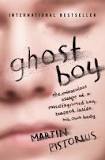
Ghost Boy:
The Miraculous Escape of a Misdiagnosed Boy Trapped Inside His Own Body by
Martin Pistorius
When he was
12 years old, Martin Pistorius, a healthy, typical boy, came home from school
with a sore throat. His conditions quickly deteriorated to the point that he
could not walk or talk, and the doctors didn’t know why. And so they sent him
home, telling his parents essentially that he would just die at some point.
Then about two years into his illness he started mentally “waking up,” but
because he was still unable to speak to his parents or caregivers or to
physically move, no one knew; therefore, the “Ghost Boy” moniker.
To go past
this point in the story would be a spoiler, so I’ll stop here and say it is a
pretty interesting story, reasonably well told.







 Posts
Posts


