Saturday, March 5, 2011

Gals Guzzle

Orlinda Naranjo, Patti DeNucci, me and Katie Sherrod - cocktails at Jeffrey's.
This was an extraordinary week for me because I reunited for the first time in 50 years with my childhood best friend, Katie Sherrod. Katie and I spent two days talking till we dropped, trying to catch up on decades of life. Katie and I don’t remember when we didn’t know each other. I pretty much grew up with her and her three brothers. That is until Katie was shipped off to Incarnate Word in San Antonio. I actually ran into Katie in 1987 when she was inducted into the Texas Women’s Hall of Fame. She and Molly Ivins, with whom Katie was a friend from their days together at the Fort Worth Star Telegram, were sitting together in the lobby of the Hyatt chatting when I spotted them. Our visit was brief, but it did reinforce my resolve to reunite with Katie at some point.

I always knew that Katie would be famous. She has received many awards for her advocacy of women's reproductive freedom and efforts to end family violence. She was also the creator and editor of Grace and Gumption: Stories of Fort Worth Women, and was Texas Woman of the Year in 1989.

After Katie arrived in Austin on Tuesday afternoon, we had dinner with my book club at Quattro Gatti, a raucous, rich and enriching muster that ended with my wine-induced announcement that I was going home to curl into the “fertile” position. Of course I meant fetal position, so we ended the night laughing our patooties off! Katie and I spent Wednesday morning at the Blanton Museum viewing the captivating exhibit, Recovering Beauty: The 1990s in Buenos Aires.

Later that afternoon, we happy hour’d at Jeffrey’s with Orlinda Naranjo and Patti DeNucci. Orlinda, aka The Honorable Orlinda Naranjo, Judge, 419th Judicial District Civil Court, is one of my very best friends and a very smart and fun gal! Orlinda is a recognized leader in judicial and non-profit circles. I fully expect to see her appointed to a federal judgeship by our next President - that is assuming we have a Democratic President of course!  Patti DeNucci is the super successful businesswoman/owner of DeNucci & Co., one of 40 female entrepreneurs featured in the new book Fearless Women, Fearless Wisdom by Mary Ann Halpin. Patti is also a soon to be published author, an outsourcing referral service, and a fellow over-reader and friend. She had us mesmerized with a story of her training in a spiritual and meditation discipline so complicated that I blanked out on exactly what it was, so hopefully she’ll comment and fill us in.

After drinks, Katie and I went to the Zachery Scott Theater to see the excellent play about Molly Ivins, Red Hot Patriot. After breakfast tacos the next morning, Katie headed back to Fort Worth and I crept back into my computer and my alter ego – Networker by Choice, Recluse By Need! A great two days with a great bunch of Very Smart Gals!

One Hundred Things My Mother Taught Me A Million Times – Chapter 66


Photo is of my mom, 1937. I have the hat she has on in this photo!

#66 – “Put bells on your doors so you can hear when people come and go.”

During a recent trip to New Mexico to see a good friend, I noticed that she had a string of bells on her front doorknob, and mom’s #66 jumped into my memory. When I mentioned to my friend that her bells reminded me that my mom had told me many times to hang bells on my doors as a security measure, my friend replied, “I just hung them there because I thought it looked cool. I never thought about it as a security thing.”

When I was growing up, people didn’t lock their doors in our little hometown of 1,200 people, and probably still don’t. When you arrived at someone’s house you just opened the door and walked in, hollering something like “Hello the house?” or “Woo hoo? Anybody home?” As the saying goes, we didn’t get a lot of strangers in those parts, so whoever walked into your house was going to be someone you knew. However, probably because she had a feral child (me) and lived alone, mom apparently wanted a little more information about comings and goings, and it worked like a charm, or perhaps I should say like a chime.

I remember hating those dang bells on our doorknobs because I couldn’t sneak out or into the house. Mom always knew exactly what time I got home from a date, all because of those bells! No matter how hard I tried, I could not open the front or back door without setting off the alarm bells! And it wasn’t like I could just remove them! Mom would either hear me, if she was home, or notice they were gone when she got home. It was a low-tech yet failsafe security system.

So mom was right, if you want to know when people are coming and going at your house, hang a string of bells on the doors. Besides, it’s a nice welcoming sound that reminds me of the bells on the doors of old shops! Tinkle, tinkle!

Sunday, February 27, 2011

One Hundred Things My Mother Taught Me A Million Times – Chapter 65


Photo is of my brother JS's class on their senior trip to Mexico. JS is second from the top on the far left. Handsome dude!!

#65 – “Before a meal, pour the tea last so the ice won't melt and dilute the tea.”

I just assumed that iced tea was a southern thing; however (and this seems completely illogical to me), the largest consumer of ice tea in the world is Japan. It is also very popular in Austria and Canada. Go figure.

We always had iced tea when I was growing up – unsweetened ice tea. Out in our neck of the woods families were either sweetened tea drinkers or unsweetened tea drinkers.  The sweetened tea drinkers were the ones missing teeth.  

Being the youngest in a family of five and having a mom who was probably very tired by the time I came along, left me to become a relatively feral kid.  I ran loose in our little town of 1,200 people, foraging for meals at my friends’ houses. I remember sitting down at their dinner tables  (every meal was at the dinner table back then) and staring at the sweating glass of tea in front of me wondering, “Sweetened or unsweetened?” One little sip and I knew whether or not I’d be returning to that home for meals. When you’re raised drinking unsweetened tea, sweetened tea is an abomination, and vice versa.

Now Kool-Aid, that’s a different deal all together. I can’t help but snicker when I read stories about horrible mothers who let their children drink beverages with caffeine and sugar. I vividly recall standing in a circle of wide-eyed kids as one of the moms poured a cup of sugar into a pitcher of Kool-Aid. My mom didn’t believe in buying Kool-Aid or sugar (except for pies), so homes that served Kool-Aid with meals were my favorite dining places. Click on Read More Below...

On Writing: A Memoir of the Craft By Stephen King

When a friend, whose opinion I value, asked if I’d read Stephen King’s book about writing (and told me she thought it was good), I knew I had to read it. Now I wish I hadn’t.

1. I started out loving On Writing: A Memoir of the Craft, but the further I got into it the harder it was to finish. I finally just skipped to the end to hear about his terrible accident in 1999 (he was walking on the side the road, was hit by a van, and nearly died).

2. I listened to the audio version, read by King, whose whiny voice was so irritating that it made me want to hurt someone.

3. His brother John Elder Robison’s stories about their childhood in his book, Look Me In The Eye, were more interesting than the autobiographical stuff that King shared in the first half of his book. I should add that saying that Robison’s was better than King’s is like saying that liver tastes better than smoked oysters. Both are hard to stomach.

4. When King got into talking about the craft of writing, he turned into every bad teacher I ever knew: condescending, arrogant and mean. I’m sure there were some good lessons in there, but between the whiny voice and the attitude they were difficult to absorb.

5. It felt like Stephen King was saying that anyone who doesn’t write like Stephen King is a hack. I don’t believe there is any one way to write well anymore than there is any one way to sing well.

I liked Stephen King’s writing a lot better before I read this book.

Thursday, February 10, 2011

New Mexico Gals Graze


Pictured, l-r, Marcia Smith, Rita Wagner, Renee Whipple (standing) and Deborah Harrington (seated)

Since some of my fan base (ha) live in New Mexico, I decided that while I was there on a faux furlough (working, but not as hard) I should have a Very Smart Gals luncheon. So, in advance I called my BFF in Silver (local dialect for Silver City) and said, “Can you convene a small group of gals for lunch?” I added that they should be interesting and smart. She didn’t let me down. We met at the lovely Tres Rosat Cafe at Cinega Spa. The setting and food were divine, as was the company! Deborah Harrington has been my best friend for nearly 30 years, but it seems we’ve known each other forever. I met her when I advertized for a roommate in Austin. We quickly figured out that we were raised about 100 miles from each other in west Texas and our bond was sealed. Deb retired several years ago from a high-level management position at Nokia, and moved to Silver where she now is an artist and a board member of the local Habitat for Humanity. She and I have traveled together a bunch, laughed till we pee’d ourselves (many times), and shared more than a few tequila shots and bottles of wine (not at the same time, tho)! She is incredibly bright, despicably tall and gorgeous, and she likes me back and thinks I’m funny. Renee Whipple (Whippledoodle to those who know and love her) is a musician and artist and works with the Mimbres Region Arts Council promoting local artists. Renee is originally from San Antonio, where she owned a music store for years. Then, following the music scene, she migrated to Los Angeles and Austin, and now Silver, where she says, “I can’t seem to leave!” Renee regaled us with stories about the music business, and impressed me with her cool head and positive attitude. Each April her family hosts a music festival somewhere around New Braunfels, so now I must go! Rita Wagner is the local vampire – technically, a Phlebotomist at the Gila Regional Medical Center, and as she says, “I’m good at it!” When I asked Rita to tell me about her life in 2-minutes, she looked seriously challenged. “I’ve just about done it all, she said.” Having been raised in the farming business, she spent a good bit of her life as a certified “Master Farmer” in the bread-belt. Umpteen lives later, she ended up in Silver. When I asked her about her “15 minutes of fame,” she said she hadn’t had it yet but it was close. She said that she’s selling her house and heading out to see the world. The next monumental natural (or man-made) disaster, she’s going to hop on a plane, show up with her syringe and tourniquets, and say, “put me to work.” I think we’ve all entertained the idea of showing up to help in a disaster, but Rita’s going to do it and I think that’s cool. Marcia Smith is another Midwest kid that went out into the world to make her mark. Gravitating back and forth between art and gourmet cooking, she’s traveled and worked all over the world, including Switzerland, Mexico where was in the cattle ranching business, the east coast where she worked for Paul Newman and Martha Stewart, and Arizona in 5-star resorts. Marcia and her husband are co-partners in the Seedboat Center for the Arts of the  Seedboat Gallery and Performance Space . Marcia is one wild and crazy gal! When I asked her about her 15-minutes, here's what she told me, which I thought was priceless. “In 1969, when I was 19-years old and working with famous artist Dennis Oppenheim on an 'earthworks' piece. We made this huge maze with 1,500 bales of hay, herded cattle thru it and they did aerial shots of it to see what the hell the cattle would do. That was what was going on in the art world at that time. Time magazine did the shots and there was an article about it in the magazine!” She added that she and Dennis “made some hay” themselves, if you know what I mean! She’s also got a story about Paul Newman showing her his “kernels” (for his popcorn), but I’m way over my 15-minutes, so I’ll just say that there are some very smart, interesting and fun gals in New Mexico!

Wednesday, February 9, 2011

Room by Emma Donoghue

When Room, which was written by Emma Donoghue, came out in September 2010, I observed its sensational popularity and decided that I definitely would not read it. Then my curiosity got the best of me, and I'm glad.

Here’s the story line: Girl is kidnapped at the age of 19 by an older dude (not sure of his age) and held captive in a sealed-off 11’x11’ room for seven years, during which time he pretty much rapes her every night. He provides very bare essentials - food, kitchen, bathroom, TV, skylight - and little else. The girl conceives and gives birth to two children, one (a girl) dies shortly after birth; the second, Jack, is raised for five years in Room.

There are several things about Room that make it a compelling read. First, just the idea of not seeing a single thing outside a small cell for seven years (except that on a TV screen). Then, imagine trying to raise a child in that situation. Donoghue was incredibly brave to take on such a storyline, and I was equally impressed at how well she handled it. The story is made particularly fascinating, although sometimes irritating, because it is told from the perspective of five-year-old Jack.

Jack’s voice and Donoghue’s writing give us a unique, and often enchanting and shocking perspective on “normal.” To Jack, Room was normal. Hiding in a wardrobe and counting his teeth to pass the time while his mother was raped was normal. Drinking milk from his mom’s breast at the age of five was normal. Jack’s descriptions of his life in Room stirred up so many thoughts and emotions never before considered that I found myself re-thinking life, and what we consider normal. Honestly, I sometimes had to stop reading because it just became too much, too horrifying, too provocative. Click on Read More Below...

Tuesday, February 8, 2011

Unbroken by Laura Hillenbrand

Since author Laura Hillenbrand’s fabulous book Seabiscuit was about a racehorse famous between 1936-38, and her recently released book Unbroken is about an Olympic track star who eventually became a WWII prisoner of war, I just knew there had to be some connection between those two topics. Sure enough, there it was on page 40 of Unbroken: Louis Zamperini’s track coach at the University of Southern California is quoted saying, “The only runner that could beat him (Zamperini) was Seabiscuit.”

Louis Zamperini, born in 1920 to Italian immigrants in Torrance, California, was trouble looking for a place to happen (smoking at age 5 and drinking at 8), so his brother Pete got him involved in the school track team. Louis set a world interscholastic record in the mile and eventually a place on the 1936 U.S. Olympic team, along with Jesse Owens who famously won four gold medals in Berlin, annoying the hell out of Hitler.

Although Zamperini is a track legend (he’s now 94 and has carried the Olympic Torch at five different games), Hillenbrand’s book is primarily focused on Zamperini’s horrific and inspiring tale of survival as a WWII prisoner of war.

I’ll spare you my soapbox speech on old men sending young soldiers off on questionable quest, and just say that I was surprised that I enjoyed reading Unbroken. I didn’t enjoy the story about Zamperini and two other guys spending 47 days fighting off sharks, hunger and thirst while floating in a tiny life raft after their plane crashed into the Pacific. But I did enjoy Hillenbrand’s treatment of the story: the heroism, survival and resilience.

I certainly didn’t enjoy the seemingly endless torture of prisoners of war in Japanese captivity – extreme hunger and thirst, men loosing half their body weight, maggot covered food, daily beatings, years of almost unbelievable deprivation. But Hillenbrand’s writing kept me turning the page. I have to admit that the entire time I was reading those parts I felt squeamishly like a “rubbernecker.” Just when you think Zamperini’s situation can’t get any worse, it does. Which at some point just makes you want to say, “Oh, come on!” Click on Read More Below...

Tuesday, February 1, 2011

One Hundred Things My Mother Taught Me A Million Times – Chapter 64

#64 – Don't pick your nose. It will make your nostrils large.

“Honey, give me a number between 64 and 112,” I yelled over the din of my hubby empting the dishwasher. I was sitting at my computer trying to conjure my muse before the three San Antonio grandkids arrived to fill my weekend with Lucky Charms, hot tub raisin-fingers and incomparable love.

“Eightyyyyy-seven he yelled back,” then asked, “What is it?” “I can’t tell you," I whined. "It’s too terrible,”

He drifted into the living room, a puzzled look on his face, cooking tongs in one hand, lime squeezer in the other and said, “You’re going to post it on your blog for millions of people to see, but you can’t tell me?” “No!” I insist, and he walks back into the kitchen shaking his head.

(SueAnn takes a deep breath here.)
OK, at the risk of ostracizing my friends and being stigmatized forever, I have a confession. My mom told me a million times not to pick my nose because as a child, I was a habitual nose picker. Excuse me while I go wash my hands and brush my teeth.

At this point, I know for a fact that my best friends are saying, “What do you mean, ‘when you were a child?’” New friend Lynn is now probably emailing me to cancel our lunch.

For gaud’s sake don’t any of you have a secret disgusting habit? OK. Here’s the deal, and way more detail than you probably want, but I feel compelled to defend myself. My nose is perpetually dry. I use tissues, I do. But sometimes the ‘you know what’ is of a consistency that it just won’t come out when I blow.

Oh the humanity! I can’t talk about this anymore. Let’s just leave it at “Mom was right, don’t pick your nose. It will make your nostrils big.” It apparently severely damages your good judgment as well. I’m going to go take a shower now.

Sunday, January 23, 2011

One Hundred Things My Mother Taught Me A Million Times – Chapter 63


Happy Birthday sweet little granddaughters 
Cassidy Grace (left) and Khloe Angelia (right)

#63 – “Put coins in a jar for your children.”
This one of one hundred things my mother taught me a million times is superficially simple but deeply complicated – at least for me. I tend to perceive my bank accounts and credit cards in a dangerously abstract way, diminishing and increasing their numbers with the speed of the Internet – reality rarely entering the equation. However, I guard a $20 bill in my purse with the ferocity of a momma bear protecting her cub.

Mom knew that when you see money going away, in a very concrete visual way, you’ll spend it less quickly, or at least think about the expenditure a little longer before emptying the “jar.” When I was a young adult carrying a checkbook, I was equally protective of the balance waving bye-bye in the right-hand column. Then banks came up with online banking, overdraft protection, and credit cards, and reality became virtual reality, and began to slowly slip down the slippery, seemingly bottomless slope.

There’s also the issue of mom not wanting me to ask her for money. Although it’s speculation on my part, it seemed as though she felt it was degrading for me to “beg,” which begs the question, why was mom so sensitive to this issue? Did she have to beg for money at some point in her life? I don’t know. Of course it could have simply been that she didn’t want me constantly harassing her for nickels and dimes (the standard child-currency of my generation).

I am absolutely positive that if I withdrew all the cash I have in banks, and put it in a home wall safe, closed all my accounts (including credit cards), and lived on a cash-only basis, at the end of the day or year I’d have a whole lot more money left over, than under my current system! So why don’t I? Because I am addicted to the drug of dreams and the illusion of possibilities. The habit of having more than I, or anyone, needs.

I am a financial child. My coins need to be in a jar.

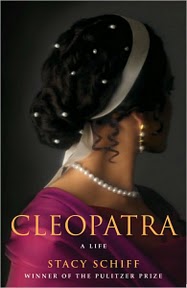
Cleopatra: A Life by Stacy Schiff


I was  living in Spain (briefly), as were Elizabeth Taylor, Richard Burton and Rex Harrison when they were filming the movie, “Cleopatra.” It was 1958 and I was 12 years old.  I remember with illogical clarity that Elizabeth Taylor, although married to Eddie Fisher at the time, fell in love with Burton. It was tabloid high drama. Then came that enormous diamond ring, but back to the “real” Cleopatra.

Well, probably not the real Cleopatra, but rather author Stacy Schiff’s “Cleopatra: A Life.” Schiff is no neophyte. She won the Pulitzer in 1999 for “Nora,” which I now must read, about Nora Nabokov, wife of “Lolita” author, Vladimir Nabokov, but back to Cleopatra.

Honestly how can we expect Schiff or anyone to get Cleopatra’s life-story accurate? She lived fifty years before Jesus was born, and her city, ancient Alexandrian, was destroyed by tsunamis and earthquakes! Besides there are no vowels in hieroglyphs!
  
What we do know about Cleopatra is that she was the last pharaoh before Egypt became part of the Roman Empire. We also know that she was 21years old when she met 52-year-old Caesar, who was married at the time, and fathered his child, Ptolemy Caesar, nicknamed Caesarion (no relation to the similar-sounding surgical birthing procedure). We also know that after Cesar was assassinated, she had three more children with Mark Antony (also married).

But most fascinating is that Cleopatra was unanimously considered a brilliant ruler who knew how to use wealth, power and intelligence to gain political and military advantage. Schiff says, “From every ancient source, we have testimony to Cleopatra's irresistible charm, to her ability to speak many languages, and to turn people to her will.” Cleopatra was making hefty economic and military decisions at the age of 13. Click on Read More Below...

Saturday, January 22, 2011

My Bountiful Organic Garden

Today I harvested
Ruffled Kale so green I felt healthier just looking at it,

the happiest red tip and leafy lettuce I've ever seen,
                    lush, aromatic and tasty cilantro, 


and carrots sweet as candy!

All the joy, none of the work, 

thanks to JBird & Company!


Jason Minshew,
son Ollie and wife, Annie Taylor

Design, Landscape, Installation, Maintenance, Edible
512-799-6723 
jbirdlandscape@gmail.com

Sunday, January 16, 2011

One Hundred Things My Mother Taught Me A Million Times – Chapter 62

(Photo is of my dad - probably taken around 1940-ish)
#62– “Never curse or use profanity. It makes you common.”
I woke up this morning in such a foul mood I wasn’t sure I should write about mom’s #62. I dreamed that my husband and I went out to a bar with friends, something we never do now that we’re boring, and the outfit he was wearing looked much better than mine! It was horrifying!!

He had on a fabulous pink plaid Christian Dior blazer, a pink Ralph Lauren Polo Shirt and Jeans, and it was stunning against his tan skin and perfectly white hair. I looked absolutely frumpy next to him in my style-less rags, and that really pissed me off, which brings me back to mom’s #62, "Never curse or use profanity. It makes you common." Oh, and we were all carrying Louis Vuitton diaper bags, but enough about my red meat induced nightmares.

Mom never cursed or used profanity. Well, that is not exactly true, she did say “dee-earn,” which was no doubt a tamed down “damn,” and only pulled out in the direst of situations.

She also said hell, but only when we were playing Hell, a fabulously frenetic and fun card game that required you to shout “Hell!” when you played your last card to win the game. I remember my normally sedate sister Dorothy slamming her last card down in the middle of the table and breaking it in half as she screamed “hellllllll” in victory!

Other then during a game of Hell, we didn’t even say hell when we were referring to hell. We said “Hades” or “the bad place.” I remember sitting in church and snickering like Bevis and Butthead with my friends  every time the preacher threatened “hell and brimstone,” which by the way is an idiomatic expression (my new word for the day – meaning a figurative meaning).

Mom also said fiddlesticks, the derivation of which is curiously cryptic. There’s the obvious violin connection, and fiddles are also a raised ledge that keeps things from sliding around on boats. My hubby says it’s just a substitute for fuck (sorry mom). Click on Read More Below...

Friday, January 14, 2011

Five Worst Books Read In 2010


Wishful Drinking 
By Carrie Fisher
Maniacal.


Up till Now 
By William Shatner
Dull.

Waiter Rant 
By The Waiter
Rhetorical.

  The Secret Life of Marilyn Monroe 
  By J. Randy Taraborrelli          
  Transparent.


   Eaarth 
   By Bill McKibben
   Depressing.

   The Unnamed 
   By Joshua Ferris
   Tedious. 

Monday, January 3, 2011

My Favorite Books - 2010

Here are my picks for the top three books read in 2010, all of which are described briefly below along with other favorites, under the categories of Fiction, Non-Fiction and Published Prior to 2010. I would love to know your favorites for 2010, so please comment:

#1 The Immortal Life of Henrietta Lacks by Rebecca Skloot

#2 Full Dark – No Stars by Stephen King

#3 The Woman Behind The New Deal: The Life of Frances Perkins, FDR'S Secretary of Labor and His Moral Conscience by Kristin Downey (published in 2009)

TOP FIVE – FICTION 2010
Full Dark – No Stars by Stephen King
Four detestably satisfying tales of human depravity set in the context of everyday people. I haven’t read Stephen King in years, and perhaps that is why I relished this book. It is right up there with King's The Girl Who Loved Tom Gordon, but jucier - if you know what I mean!

Backseat Saints by Joshilyn Jackson
Joshilyn Jackson had me at “"It was an airport gypsy who told me I had to kill my husband." Backseat Saints, as well as all of Jackson’s books, are full of southern characters and culture (minus the caricatures), and plenty-o-plot, red herrings and suspense.

Little Bee: A Novel by Chris Cleave
Beautifully written story of a young girl from Nigeria (Little Bee), whose life, under horrifying circumstance, becomes entangled with those of an English couple visiting Nigeria on holiday.

Girl in Translation by Jean Kwok
A coming of age story, but the context in which it is told, the enormous cultural crevasse between China and America, makes it exceptional. If Jean Kwok can write beyond the reflection of her own history (she, like her main character Kimberly immigrated from China to Manhattan), we’re in store for more wonderful stories!

House Rules by Jodi Picoult
Picoult always takes on controversial topics, and presents them interestingly. She also writes lots of books, but it seems they’re always just a baby-step away from fabulous. House Rules is about autism and murder.

TOP FIVE - NON-FICTION 2010
The Immortal Life of Henrietta Lacks by Rebecca Skloot
Story about a poor black woman whose cancerous cell samples were taken without her consent shortly before she died of cervical cancer in 1951, and were eventually grown in massive vats, leading to a cure for polio, breakthroughs in gene mapping and a multi-billion dollar industry.
Click on Read More Below...

One Hundred Things My Mother Taught Me A Million Times – Chapter 61


(This is the house I grew up in. Funny, I thought we were rich and our house was huge!)
#61– “Take good care of your teeth.”
Some of the things mom taught me a million times just seem so obvious, like #61, “Take good care of your teeth.” But when I was busy being a teenager, a college student, a wife and mother, and a career woman, taking care of my teeth didn’t seem that important – probably because I have superior teeth. Case in point (an idiom - my word of the day), my dental appointments go something like this...

Receptionist: “May I help you?”
Me: “I have an appointment.”
Receptionist: “Are you a new patient?”
Me: “No, I’ve been a patient of Dr. O’s for 20 years.”
Receptionist: “Well, I’ve been Dr. O’s receptionist for 20 years and I don’t remember you.”
Me: “I know. You never do. I’m the one that you never make any money off of.”
Receptionist: “Oh yes, I remember you now.” 
You would think she was paid a commission.

Actually the only person excited to see me is the dental hygienist, who always remembers that I’m such an easy cleaning job that she can plan her vacation and write poetry while working on me.  I also know that at some point I will become the dental equivalent of a cadaver. Click on Read More Below...

Saturday, December 18, 2010

One Hundred Things My Mother Taught Me A Million Times – Chapter 60


(This photo of my dad, which I don't think anyone in our family has seen before, was taken when he was about 39 years old, right around the time he married my mom.)
#60– “Put a pillow at your back.”
This one of one hundred things my mom taught me a million times just joined the list yesterday. It’s funny how things trigger memories. I was rearranging the 6 pillows in my living room chair (my office), and the memory just popped up like a cartoon caption bubble! “Put a pillow at your back!”

There’s so much irony in this lesson that I hardly know where to begin. Let’s see, there’s the dearth of pillows in my childhood home, the fact that I am a “pillow pig,” the infectious aspects of pillow hogging - oh well, I’ll just dive in and see where this memory leads me.

I’ve heard that people who survived the Nazi concentration camps were prone to obesity later in life.  Pillows were few and far between in our house, and usually homemade and virtually flat. As a result, pillows are important to me -  a measure of opulence and a source of solace. When most little girls were dreaming of marrying prince charming, I dreamed of owning as many pillows as I wanted –pillows in every room of every size, shape and color, pillows to burn. I remember when the zillion pillows on your bed trend first surfaced. I would stare dreamy-eyed at the pictures in Better Homes and Gardens.

I have lots of pillows, shop rather obsessively for them (FYI, Garden Ridge and Tuesday Morning are the best sources), and keep Goodwill well stocked in cast-offs. Let's see, I have 12 pillows in my living room, 6 in the Cowboy Room (masculine bedroom), and12 in the Frou-Frou room (feminine bedroom). My hubby put his foot down on too many pillows in the master bedroom and the lounge (where he spends his leisure time). Also, no pillows in the bathrooms or kitchen. He can be so unreasonable sometimes! Click on Read More Below...

Life by Keith Richards

Keith Richards' begins his autobiography, Life, with “Believe it or not, I haven’t forgotten any of it.” then goes on for 576 pages (23 hrs - audio version) to prove it.

When in Life, Richards talked about the process of writing the Rolling Stones music, I forgot that he was a horrendous heroin addict. I even forgot that Johnny Depp was reading the audio version (I listened to it on my iPod), and I felt myself falling into the book, comfortably. I’ve seen this same phenomenon in other musicians’ biographies (e.g., Jimi Hendricks and Eric Clapton). They’re adept, exacting and soulful about their music, but complete morons when it comes to managing their lives and relationships. But even the horror of Richards' life was irrationally compelling. I found myself strangely interested in his vivid, albeit macabre, descriptions of his drug use. I know, just stay with me here.

If you’ve any interest in the Rolling Stones, this is an admittedly one-sided yet seemingly thorough and absolutely entertaining chronicle. And you might enjoy Life if you’re simply interested in music history or trivia. For example, the Rolling Stones never wanted to be a rock and roll band; they wanted to play Chicago blues. Or that Veronica Bennett of the 60s hit girl group the Ronettes (Be My Baby) was a major fox and Keith's first serious crush, but she married famous music producer Phil Spector who was apparently a complete a-hole. Or that the Beatles and the Rolling Stones would exchange music when one or the other (usually the Stones) got writer’s block. I loved Richards' story about he and Mick Jagger cutting out newspaper and magazine headlines, tossing them on the floor, and then grabbing them randomly for song lyrics. Click on Read More Below…

Sunday, December 12, 2010

One Hundred Things My Mother Taught Me A Million Times – Chapter 59


#59– “Make sure you have plenty of beds for family.”

 (Happy 10th Birthday Sweet Granddaughter Syd)

I’m not sure why, but it galls me when I have to admit that I’ve adopted one of my mother’s particularly weird idiosyncrasies.  Do you ever wonder why nasty words like gall, which is a “tumor-like growth of burrowing insect larvae,” and “the greenish, profoundly bitter-tasting fluid in bile ducts,” aren’t profanity? I didn’t think so, but back to beds and mom’s idiosyncrasies.

My mom’s genetic makeup evidently included a “not enough beds” code. Perhaps it evolved from generations of bed sharing by too many kids. I don’t know, but whatever the reason, we had beds all over our house. They were in the bedroom like normal homes, but each of our bedrooms contained at least two full-sized beds. There were also beds on the porch, beds in the living room, and even beds on the front yard. All predicated on mom’s eternal hope that all her chicks (kids) would come home with family in tow.

Let’s see, if everyone was home at the same time, which would be mom’s five kids, their five husbands/wives (total, not each), and their fourteen kids (total, not each) – that would be 24 people (not counting mom). If everyone slept two to a bed, that’s 12 beds. So mom’s logic wasn’t really that off I guess. However, (1) No doubt to mom’s dismay, I don’t think all 24 of us were ever in mom’s house at one time, and (2) That’s probably a good thing, as parricide (killing a close relative – my new word) would have undoubtedly occurred.

I should admit that the beds on the porch and front yard were mostly about the heat of summer and no air conditioning. Central air wasn’t common in our neck of the woods, and the “swamp cooler” wasn’t turned on unless it was so hot the pavement was still liquid at midnight. Click on Read More Below...

Feliz Navidad

Click on the green arrow below...
Personalize funny videos and birthday eCards at JibJab!

Monday, December 6, 2010

Brilliant Holiday Gift Ideas!

Stumped for ideas for holiday gifts  - I have the perfect solution!

I recommend that you give a generous holiday gift to one or more of the below organizations in honor of family and/or friends. I did and it felt GREAT!

The Arc of the Capital Area provides critical services for children and adults with intellectual/developmental disabilities (autism, mental retardation, cerebral palsy, Down syndrome). One of their programs is Arc of the Arts, in which their clients create amazing works of art. Click here to check out the really cool stuff they are selling that would also make super holiday gifts. Click here to make a donation.

Austin Community Steelband teaches  "at promise" kids to play Steelpan to instill self-esteem and to preserve the cultural music of Trinidad. Need some special music for an event? These kids and their music will fill your heart with joy! This is a "shoe-string" organization that really needs your help. Click here to make a donation.

El Buen Samaritano Episcopal Mission provides medical, human and education services to working-poor Latinos in south Austin. Their comprehensive services help primarily immigrant families integrate well into our community. Click here to make a donation.

Catholic Charities of Central Texas provides health, human services and social justice advocacy in a 25 county area. I particularly like their vision of "a more just and caring society." Check them ouT and then Click Here to make a donation.

The Center for Child Protection provides protective and healing services for children who are suspected victims of sexual and physical abuse, and children who have witnessed a violent crime. Click here to make a donation.

Sustainable Food Center envisions a food secure community where all children and adults grow, share and prepare healthy, local food. These are the folks that do the Farmers' Markets, but they do much, much more. They are cultivating generations of healthy kids in Austin, and that is important. Click here to make a donation.

Sunday, December 5, 2010

One Hundred Things My Mother Taught Me A Million Times – Chapter 58


#58– “Never pull the skin on your face.”
(My sisters left to right are Gloria Sidney, Dorothy Belle and Vienna Mae – all of whom are on the far side of 70 and the short side of 80! We may all need a neck job, but the skin on our faces looks dang good.)

Us Wade gals are genetically blessed when it comes to skin. I say this not in reference to my skin, but rather in reference to the skin of my mother (right up until the day she died at the age of 98) and my three older sisters, all of whom are still kicking and have complexions that look younger than their years. Or perhaps it is simply because of mom’s #58, “Never pull the skin on your face,” which she taught us a million times.

Mother knew that mean ole’ Mr. Gravity needed absolutely no help when it came to the pulling of skin. Honestly, you’d think that some genius would have solved this problem by now. Why we didn’t push our daughters into medical research seems ridiculously illogical at this point in my life!

I just got off the phone with a friend. We were contemplating the creation of a really low budget fat farm, like $10/day. A place that doesn’t mess around when it comes to “helping” you lose weight - sort of a “Super 8” of spas. Here’s how it would work. You sign an irrevocable contract stating how much weight you want to lose. Then you are locked in a bare-bones room with only water to drink, no food. Then, no matter how much you beg and cuss, they won’t let you out until you drop the weight. I honestly think there may be a market for this. I know that’s the only thing that would work for me anyway – affordable, effective, bada-boom. 

So back to #58 and our skin.  I brought up the affordable spa thing because our face, our weight, our hair, the way we dress – in a word, vanity, is such a dominant theme in most of our lives, and which also has some pretty scary religious implications! I looked up vanity and found a smorgasbord of reference, none of them good. Click on Read More Below...

Saturday, December 4, 2010

At Home: A Short History of Private Life by Bill Bryson

Bill Bryson couldn’t write a bad book if offered a considerable sum of money to do so. Oh wait, I actually think that may have happen. The only book of his that I really didn’t cotton to, The Life and Times of the Thunderbolt Kid, was comparatively lame. Speaking of which…ever wonder where the phrase “cotton to” came from? I didn’t think so, but of course that will not stop me from edifying you on the etymology. Briefly (please, no need to thank me), cotton was a very soft and “likable” fiber, so by the 17th century cotton evolved to “taking a liking to.”

At this point you’re probably wondering what etymology has to do with Bill Bryson’s latest book, At Home: A Short History of Private Life, and the answer is simple. Everything! In At Home Bryson tracks the etymology (I’m practicing using my new word) of various rooms and features of houses, and the stuff commonly found in them. Specifically he is writing about his home, a former Church of England rectory built in the 19th century. In the process we learn useless minutia such as why cabinet refers both to the advisors to a President and a box full of medicine and cosmetics on the wall of a bathroom, and why toilet water refers both to perfume and the contents of the commode.

In the hands of just about anyone else the topic could be stupefyingly dull, but Bill Bryson can describe drying paint and have you hanging on his every word and laughing yourself to tears. At least that is my opinion, but not everyone agrees, especially with regard to At Home. My husband said he found it dry.

And not everyone becomes as titillated as I at learning that parks arose from a need for more places to bury people. So graveyards were moved from churches to open areas with lots of trees that attracted people. Next thing you know, Charles Darwin is sent about to gather more interesting plants for the cemetery “parks,” which as you know led to a change in how we look at our very existence! Bryson’s diatribe about parks evolved from his exposé on the home garden, or what us “amerkins” call the yard.

The whole issue of dressing rooms and vanities brought up a plethora of puzzling and repugnant stories. For example, Beau Brummell (pictured to the right - who I’ve heard referenced but never really knew who he was) was sort of the Paris Hilton of his time (1800’s). Apparently, he dressed so elegantly that he “attracted a daily audience that included the Prince of Wales, three dukes, a marquis, two earls and others who assembled in his dressing room to watch him bathe, dress and ready himself for a day of looking utterly smashing.” That’s just weird. Click on Read More Below...

From My Garden

The joys of a beautiful organic garden - thanks to my Garden Guru - tomatoes and lettuce - picked today - eaten today:


Jason Minshew and Annie Taylor
JBIRD & COMPANY
jbirdlandscape@gmail.com
512-383-8956

512-799-6723
4018 Clawson Road
Austin, TX  78704

Sunday, November 21, 2010

One Hundred Things My Mother Taught Me A Million Times – Chapter 57

#57– “Turn the lights off when you leave a room. It saves electricity and helps keep the house cooler.”
(This is my mom’s college graduation photo, which was taken when she was approximately 50 years old and had raised five children. She had also graduated from high school just a few years earlier.)

Our generation is pretty self-righteous about “saving” the environment. Some seem to think this generation invented conservation and environmental consciousness and that environmental heathens are ruining everything. I have a slightly different opinion about that. In the words of Pogo, “We have met the enemy and it is us!”

Since the beginning of time everything in our known environment has been evolving, and some of the earth’s characteristics and inhabitants haven’t and won’t survive, probably including us. Which brings me back to mom’s #57, “Turn the lights off when you leave a room. It saves electricity and helps keep the house cooler.”

I suspect that mom had a tiny carbon footprint, as she was religious about recycling and conserving even up till the day she made the ultimate sacrifice and stopped breathing oxygen in and carbon dioxide out. Somewhere along the way I guess I adopted #57 from mom. I am constantly following my hubby around turning off lights, TV’s, radios and anything else that sucks electricity. Don’t get me wrong. I’m not really a very dedicated environmentalist. I just think that we don’t give much credit to the good land stewards and conservationists that have been around for a very long time, like my mom. We didn’t invent this stuff; we’re just looking down the throat of a disaster that has been creeping up on us for a very long time, and now we’re scrambling. This is a good thing. Click on Read More Below...

Packing for Mars: The Curious Science of Life in the Void by Mary Roach

Mary Roach has an amazing curiosity, is a very competent researcher and writer, and is FUNNY (not that dissimilar to Bill Bryson), and these combined elements,  create one hell of a entertaining read. Nearly everyone, including me, went crazy for her first book Stiff: The Curious Life of Human Cadavers, which was about more than anyone could ever want to know about dead bodies. Then she stumbled into her next book Spook: Science Tackles The Afterlife, rebounded pretty good with Bonk: The Curious Coupling Of Science And Sex, and now in Packing for Mars: The Curious Science of Life in the Void, she’s packed the pages with space travel trivia not ordinarily covered by NASA (or anyone else for that matter).

Roach covers peeing, pooping, farting, barfing, sweating, and sex (acts that significantly rely on gravity, which isn’t readily available in space). She shares much (almost too much) history about the space race between the US and Russia, but since it’s mostly stuff I’d never heard before or have forgotten (“thank you Teflon brain”), it was interesting. She interviewed a wad of ex-astronauts (aren’t they all?) and that was sort of interesting, too.

But the part I liked best was the extraordinary NASA and science focus on trying to help humans function in space. Apparently we’re not meant to go where no man has gone before. The lack of gravity really messes us up, and the length of time it takes to get anywhere is longer than anybody wants to spend with anyone else in a capsule the size of an SUV. Packing for Mars brings to light just how daunting a task this is. As such, I don’t think we’ll need to worry about packing any time soon.

On a final note, I would add that I listened to this book on my iPod and wished I hadn’t. In spite of fascinating factoids, and Mary Roach’s spanking good writing and fab sense of humor, Sandra Burr’s monotone reading of the audible version dang near put me into a coma. Do not listen to Packing for Mars but read it. It’s fun.