Sunday, April 24, 2011

This and That

WEST TEXAS FIRES:
This photo (left) was taken from my son's front yard on the kids' ranch in west Texas during the worst of the fires. Fortunately, the fire didn't make it to their house, but the power lines burned so they were without electricity for a couple of days.
Fires all over Texas! Horrible! Too much wind, too little rain!

HAPPY BIRTHDAY TO ME!:  
Hubby and me  (right) on our way to the Broken Spoke to do a little chicken fry eatin', Lone Star drinkin', and belt buckle polishin' for my birthday.  Didn't stay long as we're just not that into late nights anymore, and I can only drink two beers, but it was still fun.

NEW MEXICO VS TEXAS ROLLERGIRLS:
Photo (left) is of best friend Deb and her boyfriend Joe (visiting from New Mexico), double-teaming a Ramonas Rollergirl (c). Deb, Joe, Crouse and I had a blast watching the Texecutioners Rollergirls annihilate the Cincinnati Black Sheep Rollergirls last Sunday at the convention center.  Not sure of this rollergals name, but it was probably something like The Killa Sal Monella, Babe Ruthless, or Sinnerfold.

G'RAJ MAHAL:
After rollergirls we rolled over to Rainey Street for   samosas, curry, naan, fab lamb, and Gypsy music. Magic!

Saturday, April 23, 2011

Half Broke Horses by Jeannette Walls


When an author writes a book that is smashingly popular, i.e., Jeannette Walls’ The Glass Castle, I tend to avoid their next book, suspecting that the publisher is capitalizing on the author’s momentum to sell inferior work. I loved The Glass Castle; had put Walls on a pedestal; and didn’t want to be disappointed by Half Broke Horses. I wasn’t.

It didn’t take long for Walls to hook me. First sentence out the chute told me she knew about animals, “Those old cows knew trouble was coming before we did.” Then on page six she revealed that the subject of her book, her grandmother, Lily Casey Smith, was born in West Texas near the Pecos River. So was I. Lily was a horsewoman born in 1901. My mom Willie was a horsewoman born in 1907.

Story goes like this. Lily Casey was born in a sod house on a desolate Texas prairie to a couple of eccentric parents (mom a wannabe “Lady,” dad preoccupied with litigation over disputed land). Even as a small child seems Lily had more sense then the rest of the family put together. As she said, “I used to break horses. I know how to take a fall.”

After the family moved to New Mexico, Lily was sent to boarding school in Santa Fe, but her father blew the tuition money on four Great Danes, which he saw as an investment. So at the age of 15, Lily strides her half broke horse Patches and rides 28 days, by herself, to northern Arizona to take a job teaching in a one-room schoolhouse. And although she drinks, races horses for money and plays a mean hand of poker, she gets fired for telling Mormon girls they have a choice. Click on Read More Below...

Unfamiliar Fishes by Sarah Vowell


Beyond James Mitchner’s book Hawaii, my minimal recall of the history of Pearl Harbor, and my 17-day stay on the island of Molokai in 2009, I didn't really know much about Hawaii. After reading Sarah Vowell’s new book, Unfamiliar Fishes,  I’m not sure I'll ever eat pineapple again (Apparently Mr. Dole was an a-hole, robber baron).

The leading 1800’s Hawaiian historian, Davida Malo, leery of the missionaries’ descent upon Hawaii, wrote of his concerns that "unfamiliar fishes" would soon dominate the islands. He wasn’t wrong. Vowell’s latest and typically unique and clever perspective on history is nevertheless a too familiar story of how religion and greed justify their plunders.  

Vowell parallels the United States’ manifest destiny rape of the Native American culture to that of Hawaii; however, she doesn’t play the Hawaiians as poor victims, but rather participants in their own demise. I liked what one reviewer said, “She [Vowell] has not written a story of good and evil, choosing sides between missionaries and those who ended up losing their land and, in many cases, their lives. This is the story of real people who each had their own reasons for their actions. That doesn't make particular actions right or acceptable but it does allow us knowledge of how events unfolded in a very complex clash of cultures.” 

This line from the book will give you a snapshot of Vowell’s humor  - in this case, re: well-meaning missionaries. "In America, on the ordinate plane of faith versus reason, the X-axis of faith intersects with the Y-axis of reason at the zero point of 'I don't give a damn what you think.'"  Click on Read More Below...

Smart Gals Graze

After a whirlwind trip to San Antonio Thursday (see post below), I tore back to Austin in time for lunch at Z'Tejas Grill Arboretum with Debbie Kern (left) and Benita Giller (right).

Debbie is the Chair of the Children’s Advocacy Center Christopher’s Guild PlayBingo Ladies Luncheon, and Benita is donating some handmade jewelry for their silent auction. If you don't have your table or tickets for this event yet, better hurry! It always sells out because it is crazy fun!
I met Austinite via New York Benita in Italy, and we became fast friends! Benita not only makes great jewelry, check out this post-card sketch and watercolor she did when we were in San Miguel a couple of years ago. She is just one of those hyper-creative people.

Debbie is simply superwoman. She just lost 20 pounds for gauds sake! I could go on and on about her, but suffice it to say that I worship her.

Debbie and Benita and I are convinced that we need to make a trip to Santa Fe together, and if I can find the money and time, I may go to London with Debbie in May!

Woo Hoo! I adore these two smart gals!!

HOPPY BUNNIES


I broke the law all the way to San Antonio Thursday morning so that I could hug and gloat over my grandchildren Cassie-4 (below), Will-5 (right) and Sydney-10 (left), at Grandparents day at St. Mary’s Hall.  I look forward to driving to Alpine next weekend to watch Quenten-8 take all the ribbons and probably a belt buckle at a horse show while his 15-mo-old sister Khloe winds me further around her little finger (photos next week!)


Click on the arrow below to see funny bunnies (clockwise) Will, Cassie, Khloe, Quenten and Sydney sing and dance - pretty funny - very cute!
Personalize funny videos and birthday eCards at JibJab!

Monday, April 11, 2011

Smart Gals Sip


Lynn Meredith and Katherine McAllen (l-r)

Yours truly could have sat and listened for hours to Lynn Meredith and Katherine McAllen converse. Their discussion about the Jesuits made me want to rush out and buy a book about this mysterious and completely fascinating order of “God’s Marines!” - but back to Lynn and Katherine.

Before Lynn, Katherine and I met for drinks on the patio at the Four Seasons last Thursday, I actually knew more of Lynn than about her. I knew that she was notoriously sharp, and that she and her husband are former Dell-ites and active in many local philanthropic activities. But what I now know is that Lynn is also an enjoyable, interesting gal. We talked about blogging, kids, living downtown, the adorable necklace she was wearing and which I so coveted (see photo above), and lots of other things that gave me a tiny peek into her world.

Katie McAllen is my daughter’s sister-in-law, and one of my favorite people. She and her husband live and ranch in South Texas and have two precious little kiddos. I wanted Katie and Lynn to meet because of their mutual interest in the Blanton Museum. Katie is on the verge of completing her PhD in Art History at Harvard, and has made several talks at the Blanton, and Lynn and her family are great supporters of the Blanton.  Sure enough, the magic happened and before long Katie and Lynn had forged a relationship that I believe will lead to good things.

One of the “fun-est” things about bringing gals together is when we discover the “Kevin Bacon degrees of separation” between them. When I asked Katie where she and the family were staying while in Austin, she said, “We’re staying with Kay and Eric Moreland,” to which Lynn replied, “I just sent Eric an email this morning!”

As we were leaving, Katie told Lynn that she’d like to pick her brain sometime about the intricacies of board service. I later told Katie that she couldn’t find a better mentor. I know that when the going gets tough, savvy boards get Lynn. Bringing these two Very Smart Gals together wasn’t easy because they are both crazy busy, but it was completely worth the effort! 

One Hundred Things My Mother Taught Me A Million Times – Chapter 69

#69 - "You can get away with wearing short hair because you have good features."
Photo is of me and my oldest granddaughter, taken this weekend at Amy's.
What mom was trying to teach me through #69, is not entirely clear to me,  but it feels like a backhanded compliment. Like the one I got from an 18-year-old cutie when I was 30-something, “You’re pretty sexy for an old lady.”

Mom was an enigma. She was a feminist and patriarchal, so #69 is typical of her teaching. She apparently didn’t think that women should wear short hair because it made them less feminine, but you could “get away with it” if you had good “features.”

One of the bases for Mom’s #69 was that she was always very self-conscious about her ears, which admittedly were a little large. I remember mom saying how relieved she was when I was born with small ears, as though I would have been tossed off a cliff if they were unacceptably large! Tragically, I think my ears are getting larger with age – especially my lobes, which after years of heavy earrings and jumping up and down to music at rock concerts (many years ago), have sagged to near-comical proportions. One of these days when I have money to burn (ha ha), I may have them reduced to little delicate petals!

And my nose - well, my dad used to say, “The reason the Wades have such big noses is because they keep them out of other people’s business and give them a chance to grow!” Mom and dad both had prominent noses, so I was inescapably destined to have a substantial schnoz. Click on Read More Below...

Monday, April 4, 2011

HELL ON WHEELS!

I bought VIP tickets again this year for the Texas Rollergirls. You may recall that Rachel Muir went with me last year and we had a blast. If you’re interested and available on one of the below dates, let me know ASAP first come first served!

Sunday, May 15
Saturday, June 11
Saturday, Aug. 6

Still Alice by Lisa Genova

I will never know my mom’s last thoughts because she couldn’t organize or articulate them. I didn’t think she had last thoughts. After reading Still Alice I’m not so sure. I wish I’d read Still Alice before my mom died.

Still Alice by first-time author Lisa Genova is a novel about a Harvard professor at the height of her career, who at the age of 50 develops early-onset Alzheimer’s. The fact that my book club argued about whether this was a true story or not (it is not) is a clear indication to me of just how real the story felt. My mom didn’t die of Alzheimer’s, but she did struggle with dementia and eventually lapsed into total disconnect being unable to recognize family, lacking the ability to articulate, etc.

Although Still Alice is a work of fiction, I tend to believe Lisa Genova’s portrayal of Alice and her illness, and how her illness affects her family for the following reasons:
1. Lisa Genova graduated valedictorian from Bates College with a degree in Biopsychology and has a Ph.D. in Neuroscience from Harvard University. She has done research on the molecular etiology of depression, Parkinson's disease, drug addiction, and memory loss following stroke.
2. Still Alice felt like a close friend, updating me on her life over a cup of coffee, intimate and palpable.
3. The fact that the story is told from the perspective of Alice, as she descends into Alzheimer’s, made it raw with tension.

I won’t disclose more about how the story unfolds because that is part of the “intrigue” that makes this a great read. I’ll just end with this: If I could go back in time to when my mom became mute and disconnected, I would say to her, “I understand that you have thoughts that you cannot express, so I want you to know that I realize this and am sorry that you cannot express those thoughts. I also know that you love me as much as I love you.”

You Know When The Men Are Gone by Siobhan Fallon


Occasionally I receive free uncorrected proofs of books from publishers. Assumedly they’re hoping I’ll read the book and publish a positive review on my blog. 

When I received You Know When The Men Are Gone by Siobhan Fallon and saw that it was about military families stationed at Fort Hood, Texas my first thought was, “Oh great, more glorification of war.” However, I couldn’t not read it because Fort Hood is practically in my “hood.”

So You Know When The Men Are Gone is eight loosely connected short stories that portray the domestic side of war; a glimpse into what life is like for military families when the spouses are deployed to dangerous war zones. One of the most interesting things about this book was that the issues, challenges and problems the families encountered had less to do with their military circumstance than just plain ole’ life. They struggled with the same stuff everyone struggles with (but in the context of military life and middle-eastern deathtraps): money, children, marriage, class distinction, etc.

It took me about 10 pages to get into Siobhan Fallon’s writing rhythm, but after I did it became comfortable, enjoyable, and sprinkled with ‘aha’ and ‘wow’ moments. And I should add that although I was a little surprised at the commonality of the issues that created tension in the book, I was also fascinated by the context (military life), so that aspect of the book wasn’t lost on me.

My sister’s husband was career military and several of my summers were spent with them on military bases, so I was somewhat familiar with that lifestyle (very self-contained, separate, like a community).  But I didn’t get much insight into the strain created by spouses being exposed to combat, injury, and death. I guess we all worry about our loved ones’ safety, but I couldn’t quite wrap my head around the concept of my hubby, son or daughter in daily extreme danger. Siobhan Fallon’s book didn’t enhance my imagination in that direction, but then I don’t think that was her intent. I think she really just wanted to show how everyday life looks like in military families, and she did that very well. 

Sunday, March 27, 2011

Rest in Peace Geraldine - You Earned It

Twenty-six years ago I showed my then teen daughter a photo of Geraldine Ferraro on the cover of Time magazine and said to her, “See, JoLene, you could be Vice President, or even President some day,” to which she replied, “So could you mom!”

That was an eye-opening moment for me. My next thought as I stared into her magnificently evolved soul was, “No wonder it takes us so long. We tend to expect the next generation to make the strides.” Geraldine Ferraro who died yesterday didn't. Neither did Ann Richards, Liz Carpenter, Barbara Jordan,  Molly Ivins,  Lenna Guerroro, some of the Texas female political icons of my generation, and now they're gone - but not forgotten.

It just so happened that around that same time I was invited to join the Austin Women’s Political Caucus, and although I cringed at the thought of becoming my mother (politically involved), I quickly not only joined, but agreed to become their president, eventually becoming President of the Texas Women's Political Caucus.  Fueled by Ann Richard’s run for Governor (I was on her Capital Council),  we soared. We raised lots of money, printed t-shirts that said "A Woman's Place Is In The Dome," and walked to the capital with Ann on her inauguration day.

Those were high times. But I came crashing to the ground in the summer of 1991, at the 20th Anniversary Celebration of the National Women’s Political Caucus in Washington, DC (I was on their steering committee). After floating in the euphoria of having breakfast with Betty Friedan (just the two of us), a 30 minute conversation with Gloria Steinem, and introducing Geraldine Ferraro to my wheelchair-bound, 86-year-old mom who went with me, at the closing session of the conference I heard that in 20 years, the number of women elected to the US Congress had increased to what seemed to me a very small percentage. Everyone was cheering and I was crying. How could this be!

Click on Read More Below...

Saturday, March 26, 2011

One Hundred Things My Mother Taught Me A Million Times – Chapter 68


#68 - Use petroleum jelly around your eyes.
 Eldest son Cuatro and his kids, Khloe (14 mos) and Quenten (8 1/2), (2 of our five beautiful, amazing grandchildren), playing in our hot tub.

What is it that makes me weirdly curious about mundane stuff, like petroleum jelly? Well, before I commence to bore you out of your undies with what I discovered about petroleum jelly, let me tell you about mom’s obsession with the stuff. Of course when I say petroleum jelly, I am referring to the generic name of Vaseline.  This isn’t the first time petroleum jelly has appeared in my blog because mom pretty much used it for everything. I’m absolutely not kidding:  burns, scrapes, creaky door hinges, bunions, face-and-body moisturizer, brow-line accent, lip gloss, rashes, a nostril germ blocker, cuticle softener, stain remover, diaper cream, rust preventer, makeup remover, hair conditioner, and anything that itched.

Me: “Mom, we’re out of Crisco.”
Mom: “Just use Vaseline.”

Me: “Mom, what if they launch the atomic missiles?”
Mom: “Grab the Vaseline.” 

At some point in our family’s near-history, my sister Dorothy (look up the word frugal and you’ll see her photo) decided she should concoct an improvement on mom’s Vaseline face moisturizer, so she came up with something that had a lot of glycerin in it. I never told her so, but for the 5 or so years she slathered herself with that stuff she looked like she’s been dipped in baby oil and she smelled like a chemical laboratory. The sun’s reflection off her was damn near blinding, and thankfully she’s already stopped smoking or I’m sure she would have combusted. I must admit though that to this day her face is as soft and wrinkle-free as a baby’s butt, and there’s plenty of science to support both mom and Dot’s greasy methodologies. 

Interestingly (to me anyway), petroleum jelly blocks the escape of body moisture, and glycerin attracts moisture. I should stop here with that affirming conclusion, but of course I won’t. Did you know that Vaseline dissolves condoms! Holy cats! This makes me wonder if the Catholic Church owns the Vaseline Company! Just think of all the babies born because no one ever bothered to mention this rather important detail! (No offense meant to my Catholic friends!) 
Click on Read More Below...

Saturday, March 12, 2011

True Grit by Charles Portis


Anyone with electricity has seen the John-Wayne movie version of "True Grit" and, although I probably wouldn’t switch TV channels from “Untold Stories of the ER” to watch it (again), it’s a pretty good version, winning Wayne an academy award in 1970 for his portrayal of one of the main characters, Rooster Cogburn.  

Now we have the 2010 version with Jeff Bridges playing Cogburn. Neither John Wayne nor Jeff Bridges float my boat, but the Cohen brothers do. They produced the new version of the movie as well as "Blood Simple", "Raising Arizona", "Fargo" and "Oh Brother, Where Art Thou?" Love them.

But what I really want to talk about is Charles Portis’ book True Grit, which is a story about Mattie Ross, who in 1875, at the age of 14,  hired Rooster Cogburn to catch or kill Tom Chaney, the man who murdered her father.  Although there’s nothing particularly outstanding about the story, two things about this book are: Mattie and Portis’ writing.

Portis’ writing is minimalist like Cormac McCarthy, and wry and clever unlike anyone I’ve read before. Here are a few choice examples.  Dying outlaw, about his partner who’d just shot him:  “He never played me false until he killed me.”  Rooster Cogburn challenging an outlaw threatening to draw on him: “Fill your hand you son of a bitch!”  Texas Ranger complaining when Mattie insulted him: “A little earlier I gave some thought to stealin' a kiss from you, but now I'm of a mind to give you five or six good licks with my belt.” Mattie’s response: “Well, one would be as unpleasant as the other.” Mattie, as Rooster and the Texas Ranger gallop off, trying to lose her: “Those horses can't get away from Little Blackie. They're loaded down with fat men and iron.”

When my book club read True Grit, all we could talk about was how unique and entertaining Mattie’s character was. Her argument with a horse trader is one of the best dialogues I’ve ever read. How an ex-Marine journalist like Portis ever came up with and wrote so charmingly about a 14-year-old girl is an entrancing mystery. Oh, and for the record, Portis' book isn’t about Rooster Cogburn, John Wayne or Jeff Bridges’ “true grit”; it’s about Mattie’s, and I loved it.

One Hundred Things My Mother Taught Me A Million Times – Chapter 67


#67 - Check all the fluids in the car every time you fill up with gas.
 Photo is of my dad, in the 30's. Check out that strong chin! No wonder he robbed my mom from the cradle!

This is one of those things mom tried to teach me that just never stuck. As a result, I buy a new car every two years.  OK, my logic is a little convoluted, but just stay with me. The reason I buy a new car every two years is because if my car is still in warranty, I know that the minute anything is wrong with the car the little light on my dash will come on that says, “needs service.” That annoying little message will insist that I take my car in to get the regular tune up, wheels rotated, “fluids” checked and replaced, etc. So I take it in. Not because I am responsible or  love my car and want to take good care of it, but rather because I hate that irritating little message lit up on my dash, and the only way I can be rid of it is to take it in for the freaking service!

Back in the days (old people say that a lot) when you pulled up to a service station (gas station to you whipper snappers) and 2-3 spiffily uniformed little guys dashed out to pump your gas, wash your windows and check you oil, it was comparatively easy to keep your car in good shape. However, I think the car and fuel industry guys (smell a conspiracy theory yet?) got together and screwed us (again.) I suspect that their meeting in the 1960’s went something like this: Click on Read More Below...

The Disappearing Spoon by Sam Kean

Could author Sam Kean get any nurdier looking? And this photo was probably the result of a couple of hours with a stylist. However, check out his laryngeal prominence (Adams Apple). You know what they say about prominent laryngeals! But I digress.

The Disappearing Spoon: And Other True Tales of Madness, Love, and the History of the World from the Periodic Table of the Elements, is about science from the perspective of (you guessed it) the periodic table of the elements, and as one reviewer put it, “its relation to medicine, money, poisons, explosive weaponry, temperature, tools of measurement, gold rushes, human insanity, misguided science, artistic output, and the politics of the Nobel prize.” I would just call it a pretty good science soap opera, lots of drama and gossip.

Honestly, I found it difficult to stay focused on the book until Kean pulled out zingers. Like the fact that coins, handrails and water pipes are primarily stainless steel, copper, silver and nickel, because those metals are self-sterilizing; and the fact that the term “computer” was coined when the wives of Manhattan Project scientists were put to work doing zillions of calculations. Oh, and did you know that Marie Curie was almost denied her Pulitzer because she was having an affair with a married man? Then there was the famous poet who went on Lithium to regulate his Bi-Polar Disorder and then couldn’t write jack. OK, I admit it. My zinger threshold for science is pretty low.

If you have an absurd affection for science and "People" magazine, you’d probably like The Disappearing Spoon.

Saturday, March 5, 2011

Gals Guzzle

Orlinda Naranjo, Patti DeNucci, me and Katie Sherrod - cocktails at Jeffrey's.
This was an extraordinary week for me because I reunited for the first time in 50 years with my childhood best friend, Katie Sherrod. Katie and I spent two days talking till we dropped, trying to catch up on decades of life. Katie and I don’t remember when we didn’t know each other. I pretty much grew up with her and her three brothers. That is until Katie was shipped off to Incarnate Word in San Antonio. I actually ran into Katie in 1987 when she was inducted into the Texas Women’s Hall of Fame. She and Molly Ivins, with whom Katie was a friend from their days together at the Fort Worth Star Telegram, were sitting together in the lobby of the Hyatt chatting when I spotted them. Our visit was brief, but it did reinforce my resolve to reunite with Katie at some point.

I always knew that Katie would be famous. She has received many awards for her advocacy of women's reproductive freedom and efforts to end family violence. She was also the creator and editor of Grace and Gumption: Stories of Fort Worth Women, and was Texas Woman of the Year in 1989.

After Katie arrived in Austin on Tuesday afternoon, we had dinner with my book club at Quattro Gatti, a raucous, rich and enriching muster that ended with my wine-induced announcement that I was going home to curl into the “fertile” position. Of course I meant fetal position, so we ended the night laughing our patooties off! Katie and I spent Wednesday morning at the Blanton Museum viewing the captivating exhibit, Recovering Beauty: The 1990s in Buenos Aires.

Later that afternoon, we happy hour’d at Jeffrey’s with Orlinda Naranjo and Patti DeNucci. Orlinda, aka The Honorable Orlinda Naranjo, Judge, 419th Judicial District Civil Court, is one of my very best friends and a very smart and fun gal! Orlinda is a recognized leader in judicial and non-profit circles. I fully expect to see her appointed to a federal judgeship by our next President - that is assuming we have a Democratic President of course!  Patti DeNucci is the super successful businesswoman/owner of DeNucci & Co., one of 40 female entrepreneurs featured in the new book Fearless Women, Fearless Wisdom by Mary Ann Halpin. Patti is also a soon to be published author, an outsourcing referral service, and a fellow over-reader and friend. She had us mesmerized with a story of her training in a spiritual and meditation discipline so complicated that I blanked out on exactly what it was, so hopefully she’ll comment and fill us in.

After drinks, Katie and I went to the Zachery Scott Theater to see the excellent play about Molly Ivins, Red Hot Patriot. After breakfast tacos the next morning, Katie headed back to Fort Worth and I crept back into my computer and my alter ego – Networker by Choice, Recluse By Need! A great two days with a great bunch of Very Smart Gals!

One Hundred Things My Mother Taught Me A Million Times – Chapter 66


Photo is of my mom, 1937. I have the hat she has on in this photo!

#66 – “Put bells on your doors so you can hear when people come and go.”

During a recent trip to New Mexico to see a good friend, I noticed that she had a string of bells on her front doorknob, and mom’s #66 jumped into my memory. When I mentioned to my friend that her bells reminded me that my mom had told me many times to hang bells on my doors as a security measure, my friend replied, “I just hung them there because I thought it looked cool. I never thought about it as a security thing.”

When I was growing up, people didn’t lock their doors in our little hometown of 1,200 people, and probably still don’t. When you arrived at someone’s house you just opened the door and walked in, hollering something like “Hello the house?” or “Woo hoo? Anybody home?” As the saying goes, we didn’t get a lot of strangers in those parts, so whoever walked into your house was going to be someone you knew. However, probably because she had a feral child (me) and lived alone, mom apparently wanted a little more information about comings and goings, and it worked like a charm, or perhaps I should say like a chime.

I remember hating those dang bells on our doorknobs because I couldn’t sneak out or into the house. Mom always knew exactly what time I got home from a date, all because of those bells! No matter how hard I tried, I could not open the front or back door without setting off the alarm bells! And it wasn’t like I could just remove them! Mom would either hear me, if she was home, or notice they were gone when she got home. It was a low-tech yet failsafe security system.

So mom was right, if you want to know when people are coming and going at your house, hang a string of bells on the doors. Besides, it’s a nice welcoming sound that reminds me of the bells on the doors of old shops! Tinkle, tinkle!

Sunday, February 27, 2011

One Hundred Things My Mother Taught Me A Million Times – Chapter 65


Photo is of my brother JS's class on their senior trip to Mexico. JS is second from the top on the far left. Handsome dude!!

#65 – “Before a meal, pour the tea last so the ice won't melt and dilute the tea.”

I just assumed that iced tea was a southern thing; however (and this seems completely illogical to me), the largest consumer of ice tea in the world is Japan. It is also very popular in Austria and Canada. Go figure.

We always had iced tea when I was growing up – unsweetened ice tea. Out in our neck of the woods families were either sweetened tea drinkers or unsweetened tea drinkers.  The sweetened tea drinkers were the ones missing teeth.  

Being the youngest in a family of five and having a mom who was probably very tired by the time I came along, left me to become a relatively feral kid.  I ran loose in our little town of 1,200 people, foraging for meals at my friends’ houses. I remember sitting down at their dinner tables  (every meal was at the dinner table back then) and staring at the sweating glass of tea in front of me wondering, “Sweetened or unsweetened?” One little sip and I knew whether or not I’d be returning to that home for meals. When you’re raised drinking unsweetened tea, sweetened tea is an abomination, and vice versa.

Now Kool-Aid, that’s a different deal all together. I can’t help but snicker when I read stories about horrible mothers who let their children drink beverages with caffeine and sugar. I vividly recall standing in a circle of wide-eyed kids as one of the moms poured a cup of sugar into a pitcher of Kool-Aid. My mom didn’t believe in buying Kool-Aid or sugar (except for pies), so homes that served Kool-Aid with meals were my favorite dining places. Click on Read More Below...

On Writing: A Memoir of the Craft By Stephen King

When a friend, whose opinion I value, asked if I’d read Stephen King’s book about writing (and told me she thought it was good), I knew I had to read it. Now I wish I hadn’t.

1. I started out loving On Writing: A Memoir of the Craft, but the further I got into it the harder it was to finish. I finally just skipped to the end to hear about his terrible accident in 1999 (he was walking on the side the road, was hit by a van, and nearly died).

2. I listened to the audio version, read by King, whose whiny voice was so irritating that it made me want to hurt someone.

3. His brother John Elder Robison’s stories about their childhood in his book, Look Me In The Eye, were more interesting than the autobiographical stuff that King shared in the first half of his book. I should add that saying that Robison’s was better than King’s is like saying that liver tastes better than smoked oysters. Both are hard to stomach.

4. When King got into talking about the craft of writing, he turned into every bad teacher I ever knew: condescending, arrogant and mean. I’m sure there were some good lessons in there, but between the whiny voice and the attitude they were difficult to absorb.

5. It felt like Stephen King was saying that anyone who doesn’t write like Stephen King is a hack. I don’t believe there is any one way to write well anymore than there is any one way to sing well.

I liked Stephen King’s writing a lot better before I read this book.

Thursday, February 10, 2011

New Mexico Gals Graze


Pictured, l-r, Marcia Smith, Rita Wagner, Renee Whipple (standing) and Deborah Harrington (seated)

Since some of my fan base (ha) live in New Mexico, I decided that while I was there on a faux furlough (working, but not as hard) I should have a Very Smart Gals luncheon. So, in advance I called my BFF in Silver (local dialect for Silver City) and said, “Can you convene a small group of gals for lunch?” I added that they should be interesting and smart. She didn’t let me down. We met at the lovely Tres Rosat Cafe at Cinega Spa. The setting and food were divine, as was the company! Deborah Harrington has been my best friend for nearly 30 years, but it seems we’ve known each other forever. I met her when I advertized for a roommate in Austin. We quickly figured out that we were raised about 100 miles from each other in west Texas and our bond was sealed. Deb retired several years ago from a high-level management position at Nokia, and moved to Silver where she now is an artist and a board member of the local Habitat for Humanity. She and I have traveled together a bunch, laughed till we pee’d ourselves (many times), and shared more than a few tequila shots and bottles of wine (not at the same time, tho)! She is incredibly bright, despicably tall and gorgeous, and she likes me back and thinks I’m funny. Renee Whipple (Whippledoodle to those who know and love her) is a musician and artist and works with the Mimbres Region Arts Council promoting local artists. Renee is originally from San Antonio, where she owned a music store for years. Then, following the music scene, she migrated to Los Angeles and Austin, and now Silver, where she says, “I can’t seem to leave!” Renee regaled us with stories about the music business, and impressed me with her cool head and positive attitude. Each April her family hosts a music festival somewhere around New Braunfels, so now I must go! Rita Wagner is the local vampire – technically, a Phlebotomist at the Gila Regional Medical Center, and as she says, “I’m good at it!” When I asked Rita to tell me about her life in 2-minutes, she looked seriously challenged. “I’ve just about done it all, she said.” Having been raised in the farming business, she spent a good bit of her life as a certified “Master Farmer” in the bread-belt. Umpteen lives later, she ended up in Silver. When I asked her about her “15 minutes of fame,” she said she hadn’t had it yet but it was close. She said that she’s selling her house and heading out to see the world. The next monumental natural (or man-made) disaster, she’s going to hop on a plane, show up with her syringe and tourniquets, and say, “put me to work.” I think we’ve all entertained the idea of showing up to help in a disaster, but Rita’s going to do it and I think that’s cool. Marcia Smith is another Midwest kid that went out into the world to make her mark. Gravitating back and forth between art and gourmet cooking, she’s traveled and worked all over the world, including Switzerland, Mexico where was in the cattle ranching business, the east coast where she worked for Paul Newman and Martha Stewart, and Arizona in 5-star resorts. Marcia and her husband are co-partners in the Seedboat Center for the Arts of the  Seedboat Gallery and Performance Space . Marcia is one wild and crazy gal! When I asked her about her 15-minutes, here's what she told me, which I thought was priceless. “In 1969, when I was 19-years old and working with famous artist Dennis Oppenheim on an 'earthworks' piece. We made this huge maze with 1,500 bales of hay, herded cattle thru it and they did aerial shots of it to see what the hell the cattle would do. That was what was going on in the art world at that time. Time magazine did the shots and there was an article about it in the magazine!” She added that she and Dennis “made some hay” themselves, if you know what I mean! She’s also got a story about Paul Newman showing her his “kernels” (for his popcorn), but I’m way over my 15-minutes, so I’ll just say that there are some very smart, interesting and fun gals in New Mexico!

Wednesday, February 9, 2011

Room by Emma Donoghue

When Room, which was written by Emma Donoghue, came out in September 2010, I observed its sensational popularity and decided that I definitely would not read it. Then my curiosity got the best of me, and I'm glad.

Here’s the story line: Girl is kidnapped at the age of 19 by an older dude (not sure of his age) and held captive in a sealed-off 11’x11’ room for seven years, during which time he pretty much rapes her every night. He provides very bare essentials - food, kitchen, bathroom, TV, skylight - and little else. The girl conceives and gives birth to two children, one (a girl) dies shortly after birth; the second, Jack, is raised for five years in Room.

There are several things about Room that make it a compelling read. First, just the idea of not seeing a single thing outside a small cell for seven years (except that on a TV screen). Then, imagine trying to raise a child in that situation. Donoghue was incredibly brave to take on such a storyline, and I was equally impressed at how well she handled it. The story is made particularly fascinating, although sometimes irritating, because it is told from the perspective of five-year-old Jack.

Jack’s voice and Donoghue’s writing give us a unique, and often enchanting and shocking perspective on “normal.” To Jack, Room was normal. Hiding in a wardrobe and counting his teeth to pass the time while his mother was raped was normal. Drinking milk from his mom’s breast at the age of five was normal. Jack’s descriptions of his life in Room stirred up so many thoughts and emotions never before considered that I found myself re-thinking life, and what we consider normal. Honestly, I sometimes had to stop reading because it just became too much, too horrifying, too provocative. Click on Read More Below...

Tuesday, February 8, 2011

Unbroken by Laura Hillenbrand

Since author Laura Hillenbrand’s fabulous book Seabiscuit was about a racehorse famous between 1936-38, and her recently released book Unbroken is about an Olympic track star who eventually became a WWII prisoner of war, I just knew there had to be some connection between those two topics. Sure enough, there it was on page 40 of Unbroken: Louis Zamperini’s track coach at the University of Southern California is quoted saying, “The only runner that could beat him (Zamperini) was Seabiscuit.”

Louis Zamperini, born in 1920 to Italian immigrants in Torrance, California, was trouble looking for a place to happen (smoking at age 5 and drinking at 8), so his brother Pete got him involved in the school track team. Louis set a world interscholastic record in the mile and eventually a place on the 1936 U.S. Olympic team, along with Jesse Owens who famously won four gold medals in Berlin, annoying the hell out of Hitler.

Although Zamperini is a track legend (he’s now 94 and has carried the Olympic Torch at five different games), Hillenbrand’s book is primarily focused on Zamperini’s horrific and inspiring tale of survival as a WWII prisoner of war.

I’ll spare you my soapbox speech on old men sending young soldiers off on questionable quest, and just say that I was surprised that I enjoyed reading Unbroken. I didn’t enjoy the story about Zamperini and two other guys spending 47 days fighting off sharks, hunger and thirst while floating in a tiny life raft after their plane crashed into the Pacific. But I did enjoy Hillenbrand’s treatment of the story: the heroism, survival and resilience.

I certainly didn’t enjoy the seemingly endless torture of prisoners of war in Japanese captivity – extreme hunger and thirst, men loosing half their body weight, maggot covered food, daily beatings, years of almost unbelievable deprivation. But Hillenbrand’s writing kept me turning the page. I have to admit that the entire time I was reading those parts I felt squeamishly like a “rubbernecker.” Just when you think Zamperini’s situation can’t get any worse, it does. Which at some point just makes you want to say, “Oh, come on!” Click on Read More Below...

Tuesday, February 1, 2011

One Hundred Things My Mother Taught Me A Million Times – Chapter 64

#64 – Don't pick your nose. It will make your nostrils large.

“Honey, give me a number between 64 and 112,” I yelled over the din of my hubby empting the dishwasher. I was sitting at my computer trying to conjure my muse before the three San Antonio grandkids arrived to fill my weekend with Lucky Charms, hot tub raisin-fingers and incomparable love.

“Eightyyyyy-seven he yelled back,” then asked, “What is it?” “I can’t tell you," I whined. "It’s too terrible,”

He drifted into the living room, a puzzled look on his face, cooking tongs in one hand, lime squeezer in the other and said, “You’re going to post it on your blog for millions of people to see, but you can’t tell me?” “No!” I insist, and he walks back into the kitchen shaking his head.

(SueAnn takes a deep breath here.)
OK, at the risk of ostracizing my friends and being stigmatized forever, I have a confession. My mom told me a million times not to pick my nose because as a child, I was a habitual nose picker. Excuse me while I go wash my hands and brush my teeth.

At this point, I know for a fact that my best friends are saying, “What do you mean, ‘when you were a child?’” New friend Lynn is now probably emailing me to cancel our lunch.

For gaud’s sake don’t any of you have a secret disgusting habit? OK. Here’s the deal, and way more detail than you probably want, but I feel compelled to defend myself. My nose is perpetually dry. I use tissues, I do. But sometimes the ‘you know what’ is of a consistency that it just won’t come out when I blow.

Oh the humanity! I can’t talk about this anymore. Let’s just leave it at “Mom was right, don’t pick your nose. It will make your nostrils big.” It apparently severely damages your good judgment as well. I’m going to go take a shower now.

Sunday, January 23, 2011

One Hundred Things My Mother Taught Me A Million Times – Chapter 63


Happy Birthday sweet little granddaughters 
Cassidy Grace (left) and Khloe Angelia (right)

#63 – “Put coins in a jar for your children.”
This one of one hundred things my mother taught me a million times is superficially simple but deeply complicated – at least for me. I tend to perceive my bank accounts and credit cards in a dangerously abstract way, diminishing and increasing their numbers with the speed of the Internet – reality rarely entering the equation. However, I guard a $20 bill in my purse with the ferocity of a momma bear protecting her cub.

Mom knew that when you see money going away, in a very concrete visual way, you’ll spend it less quickly, or at least think about the expenditure a little longer before emptying the “jar.” When I was a young adult carrying a checkbook, I was equally protective of the balance waving bye-bye in the right-hand column. Then banks came up with online banking, overdraft protection, and credit cards, and reality became virtual reality, and began to slowly slip down the slippery, seemingly bottomless slope.

There’s also the issue of mom not wanting me to ask her for money. Although it’s speculation on my part, it seemed as though she felt it was degrading for me to “beg,” which begs the question, why was mom so sensitive to this issue? Did she have to beg for money at some point in her life? I don’t know. Of course it could have simply been that she didn’t want me constantly harassing her for nickels and dimes (the standard child-currency of my generation).

I am absolutely positive that if I withdrew all the cash I have in banks, and put it in a home wall safe, closed all my accounts (including credit cards), and lived on a cash-only basis, at the end of the day or year I’d have a whole lot more money left over, than under my current system! So why don’t I? Because I am addicted to the drug of dreams and the illusion of possibilities. The habit of having more than I, or anyone, needs.

I am a financial child. My coins need to be in a jar.

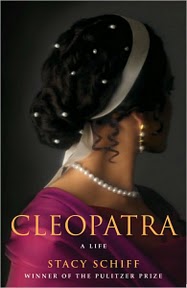
Cleopatra: A Life by Stacy Schiff


I was  living in Spain (briefly), as were Elizabeth Taylor, Richard Burton and Rex Harrison when they were filming the movie, “Cleopatra.” It was 1958 and I was 12 years old.  I remember with illogical clarity that Elizabeth Taylor, although married to Eddie Fisher at the time, fell in love with Burton. It was tabloid high drama. Then came that enormous diamond ring, but back to the “real” Cleopatra.

Well, probably not the real Cleopatra, but rather author Stacy Schiff’s “Cleopatra: A Life.” Schiff is no neophyte. She won the Pulitzer in 1999 for “Nora,” which I now must read, about Nora Nabokov, wife of “Lolita” author, Vladimir Nabokov, but back to Cleopatra.

Honestly how can we expect Schiff or anyone to get Cleopatra’s life-story accurate? She lived fifty years before Jesus was born, and her city, ancient Alexandrian, was destroyed by tsunamis and earthquakes! Besides there are no vowels in hieroglyphs!
  
What we do know about Cleopatra is that she was the last pharaoh before Egypt became part of the Roman Empire. We also know that she was 21years old when she met 52-year-old Caesar, who was married at the time, and fathered his child, Ptolemy Caesar, nicknamed Caesarion (no relation to the similar-sounding surgical birthing procedure). We also know that after Cesar was assassinated, she had three more children with Mark Antony (also married).

But most fascinating is that Cleopatra was unanimously considered a brilliant ruler who knew how to use wealth, power and intelligence to gain political and military advantage. Schiff says, “From every ancient source, we have testimony to Cleopatra's irresistible charm, to her ability to speak many languages, and to turn people to her will.” Cleopatra was making hefty economic and military decisions at the age of 13. Click on Read More Below...